By Natalie Peirce
The term ‘atom’ was first used by the Greek philosopher Democritus and stems the from the word ‘atomos’ – meaning ‘invisible’. According to Democritus, if you kept cutting up something, making and smaller and smaller, you would eventually be left with a tiny particle that could not be divided any further. This particle was known as the atom. He theorised that these atoms were infinite in number, varying in size, and moved within an infinite void. He also theorised that, when atoms collided within this infinite void, they either repelled each other or attached to each other through the use of tiny hooks or barbs.
The ideas of Democritus and his fellow atomists share a lot of similarities to how we think of the atom today – with atoms being different sizes, forming compounds, and moving within empty space. A few of his theories, however, differ quite considerably from our modern ideas. An example of this is the idea that there were no gaps between atoms and that they themselves were completely solid, indestructible, and unchanging.
Since Democritus, we have had many different theories on how atoms behave and what they look like. And, as we discovered more about the atom and its properties, we have developed many different atomic models in order to incorporate these new discoveries. Today, it is my job to show off these atomic models and how our ideas changed over time.
Solid sphere model (1803):

This first model was created by John Dalton – a scientist with a long-term interest in meteorology. It was this interest that brought Dalton to his model of the atom, as it was used to explain his law of partial pressures. While discussing his atomic theory, he describes the atom’s shape as ‘globular’, meaning spherical. Dalton’s reasoning for this was that, in spite whatever the general shape of a solid atom may be, the pressure from the atmosphere would cause atoms to be globular. Hence why this model is known as the ‘Solid sphere model’.
In his work, Dalton also proposed that the atoms of different elements were different weights and ended up becoming one of the first scientists to calculate atomic weight. He did this by using the percentage of elements in each compound, based on what he believed to be the compound’s structure. Some of his proposed compound structures include water, which he thought to be HO (comprised of 1 hydrogen and 1 oxygen atom) instead of H2O (although he acknowledges that there was a possibility that water may have had 2 hydrogen atoms in its structure instead of just 1), and muriatic acid (better known today as hydrochloric acid), which he thought to be HO3 (comprised of 1 hydrogen and 3 oxygen atoms) instead of HCl. While Dalton’s ideas may seem a bit outdated now, they were the first step into modern atomic theory and their importance must not be forgotten.
Smoke-ring model (1867):

Devised by Lord Kelvin, this model was inspired Helmholtz’s work on vortexes in perfect liquids and was quite the contrast the Dalton’s atomic theory. Kelvin proposed that atoms, instead of being round and solid entities as previously thought, were made of vortexes. These vortexes were viewed as stable and resided in an electromagnetic aether.
Kelvin also used his smoke-ring model to explain why simple bodies (substances that cannot be chemically altered or formed by using other substances) often had different properties. He suggested that these vortex atoms could knot together in infinite ways and that these different shapes were responsible for the variety and allotropes of these simple bodies, thus changing their properties.
Nucleo-planetary model (1901):

This model was thought of by Jean Baptiste Perrin and was the first atomic model to describe negatively charged particles orbiting around a positively charged centre, which explained as ‘planetary’ corpuscles (fast-moving electrons) circulating around a positive ‘sun’. He theorised that these negative ‘planets’ gravitated towards these positive ‘suns’ and that their combined charge was electrically neutral. He also theorised that if the ‘planets’ of 2 atoms were identical then their ‘suns’ would also be identical, and that the entire universe was comprised of groupings of these 2 base elements.
Unfortunately, this nucleo-planetary model, at the time of its inception, was mostly speculation which Perrin never sought to verify. This model was, therefore, initially rejected by the scientific community as there was simply a lack of evidence to support it. It wasn’t until 1911 when many of his ideas on the atom were corroborated by another scientist, who independently reached a very similar conclusion to Perrin.
Cubical model (1902):

This model was first created by G. N. Lewis and, instead of being published immediately, was used as a teaching tool. He used this model when explaining valence (the number of bonds each atom of a given element can typically form in compounds) to his students. He based his model on Abegg’s rule, which stated that the difference between the maximum positive and negative valence was usually 8. This led Lewis to devise an atomic model that took on the shape of a cube (a shape 8 vertices).
Lewis continued to build on his theory and, in 1923, he wrote about the key features of his atomic model. He described his atoms as being arranged in concentric cubes, with their inner cubes being complete with 8 electrons each and any larger outer cubes being incomplete (with the exception of rare (noble) gasses, whose outer shells were complete and, therefore, unreactive). He also stated that the electrons of outer incomplete cubes could be given to another atom, and that the number of electrons present in a neutral atom increased as the atoms got larger. Additionally, he notes that he considered that positive charges may have also been a result of their own particles, but he never implemented this into his model, instead opting to focus on how electrons were arranged in the atom and how this affected the way they bonded with one another. The positive part was simply not relevant to his work.
Dynamid model (1903):

This model was created by Philipp Lenard and was spawned from his investigations into cathode rays (better known today as beams of electrons). From his experiments, he devised an atomic model where atoms were made of tiny little building blocks called ‘dynamids’ – which themselves were made of a positive and a negative charge. According to Lenard, these dynamids were the same across all elements, and that it was the number of them in an atom that determined its atomic mass. However, the force keeping the dynamids together in the atoms was not explained.
It’s important to note that Lenard did not focus on the positive parts of his dynamids, only the negative parts. While this did lead to some important observations, including the aforementioned uniform building blocks of atoms, that electrical forces were involved in chemical reactions, and that the amount of matter actually in an atom was very, very small, he was never able to determine why only the negative parts of his dynamids could leave atoms or why the positive parts could not. His idea was certainly an interesting one, but it came with a lot of questions that, at the time, could not be answered.
Plum pudding model (1904):

Following his discovery of corpuscles (later known as electrons) in 1897, J. J. Thomson came up with his own model of the atom. In 1904, Thomson proposed that atoms were comprised of negatively charged corpuscles enclosed within a positively charged sphere, and that these charges cancelled out to create a neutral atom. He further proposed that the corpuscles inside of the positive sphere were constantly moving, arranging themselves into a series of concentric shells, in order to make the charge across the atom uniform.
Thomson’s model shares a similar appearance to a popular dessert at the time – plum pudding. When comparing his model to said pudding, his model could be explained as being a positively charged cake containing a selection of negatively charged plums inside, resulting a pudding with perfectly balanced flavours and the same taste in every bite.
This model did have some limitations, such as the ‘positive sphere’ part of his theory being poorly defined and not really being able to explain why the atom remained stable. However, it still ended up being popular among Thomson’s contemporaries and, to this day, remains one of the most recognisable atomic models.
Saturnian model (1904):

Described by Hantaro Nagaoka, this model depicts a large number of negatively charged particles, all of the same mass, arranged in a circle and repelling each other, resulting in equal spaces between them. In the centre of this circle was a large positively charged mass, which attracted to negatively charged particles as they rotated about it. According to Nagaoka, if these negative particles moved with almost the same velocity as positive ones, then the system would remain stable. This was likened to Saturn and its rings, as it had recently been discovered that the rings of Saturn were made up of many smaller satellites rotating around the planet.
An interesting aspect to note about Nagaoka’s atomic theory is that, if the rings were broken, the electrons would fly off in various directions at great velocities, and the large positive centre would continue travelling at the same velocity as it was prior. He believed that this collapsing of his atom was the source of both beta and alpha radiation respectively.
Electron fluid model (1906):

This model was thought of by Lord Rayleigh and was an adaptation of Thomson’s plum pudding model. At the time of its creation, no one knew how many electrons there were per atom and many, based on the experimental evidence that they had at the time, thought that there was a very large number of electrons associated with each atom. Building on this, Rayleigh had the idea that the number of electrons in an atom was infinite in number and formed a cloud – an irrational fluid. He described the positive sphere as remaining ‘undisplaced’, while the electron fluid was free to move within the positive sphere and distributes itself evenly.
This idea of electron fluid was expressed using Thomson’s model, as Rayleigh believed it to be the most feasible. He questioned the stability of other models that described orbiting electrons, instead of enclosed electrons, as there was no explanation as to how electrons could reliably maintain their orbit around the positive element.
Vibrating electron model (1906):

After reading Lord Rayleigh’s work on the atom, J. H. Jeans sought to voice his own theory on the atom. Much like Rayleigh, Jeans was not a supporter of systems with orbiting electron, so his model can be interpreted as an adaptation of the plum pudding model. Jeans postulated that electrons could, instead of being just a point of charge, be objects with their own, potentially complex, internal structure, and that the vibrations from these electrons resulted in atoms emitting light.
Expanding electron model (1906):

This model was described by G. A. Schott, whose research was primarily focused on electromagnetic radiation. He speculated that the electrons in an atom slowly expand over time, and that the resultant stress from this expansion was countered by some sort of internal force from the aether. He also speculated that this interaction between to electrons and the aether caused attraction between electrons. Unlike many of his contemporaries, Schott fails to mention any kind of positively charged elements to his model.
Archion model (1910):

Stemming from his research into radioactivity and light emitted by positive rays, the physicist Johannas Stark theorised that the atom was made up of several positive particles, which he named ‘archions’. Stark supposed that these archions were dipolar, like bar magnets, and were attracted to each other to form a ring. In order for the arhcions to not repel each other, he speculated that there was an electron somewhere close to each one. This would make the ring, and therefore his atom, neutral and stable.
Nuclear model (1911):

While researching the scattering of alpha and beta particles, Ernist Rutherford created his model of the atom. He describes the atom as having a positive centre and being surrounded by a sphere of evenly distributed negative electricity. Rutherford also stated that the overall mass contained in an atom was extremely small and concentrated mostly at the atom’s centre. He additionally stated that the negative particles surrounding the atom were a relatively large distance away from this dense and positive centre.
Rutherford came to these conclusions as a result of his gold foil experiments. In these experiments, a beam of alpha radiation was fired a very thin piece of gold foil in a vacuum. While most of the alpha particle passed straight through the foil, some were deflected at various angles, and some bounced right back towards the source. This disproved Thomson’s model as, if the model had been correct, all of the alpha particles would have passed straight through the foil.
It’s also interesting to note that, in the original paper discussing his atomic model, Rutherford mentions Nagaoka’s Saturnian model. He acknowledges the similarities of Nagaoka’s theories to his own and the fact that it was a coincidence that they drew the somewhat similar conclusions that they did.
Planetary model (1913):
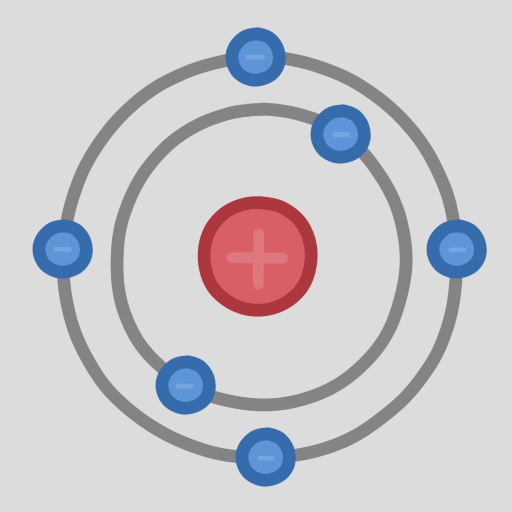
Building upon Rutherford’s work on the atom, Niels Bohr devised his own model. In this, he theorised that, instead of all of the electrons being contained within a single ring or sphere, the electrons in an atom were arranged across several rings. The electron rings closer to the nucleus would have a higher potential energy than those in rings further away. He describes these, in his work, as stationary states due to their fixed distance(s) away from the nucleus. Although, today, we just refer to these as energy levels.
Not only did Bohr discuss the arrangement of electrons in atoms, but he also used his model to explain the production of light quanta and, in 1926, Lewis would popularise the term ‘photon’ to describe these. Bohr discovered that when an electron moves from a higher stationary state to a lower stationary state, going from an outer ring to an inner ring, it results in the production of a photon and, therefore, produces light. This disproved Jeans’ theory on how an atom produces light, although he had been correct that it involved the movement of electrons.
Sommerfeld model (1916):
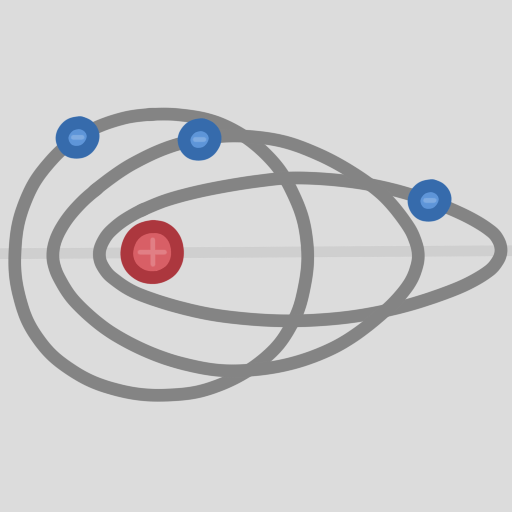
3 years after Bohr published his model, Sommerfeld published his adaptation of it. He did this after discovering that electrons moved close to the speed of light but didn’t always maintain the same speed throughout their orbit. He concluded that electrons moved around the nucleus in either a circular or an elliptical orbit, depending on the energy level of each electron. The higher the energy level, the more elliptical (or squished) the electron’s orbit. Sommerfeld’s work made quite the impression on his contemporaries, particularly with Bohr, as he described Sommerfeld’s results as important and beautiful.
Wave-particle duality model (1924):

This model was proposed as a part of Louis de Broglie’s doctoral thesis. In his thesis, he describes the electron as no longer being just a small granule of electricity but, instead, a wave. He believed that, instead of electrons keeping a simple circular orbit, electrons had an undulating orbit and that the length and frequency of its waves was determined by the electron’s energy level. The higher the energy level, the more waves there were.
De Broglie’s atom built on Bohr’s and, in fact, explained why the electrons on Bohr’s model behaved as they did. In De Broglie’s model, if an electron gets excited and gains sufficient energy then it is able to go up an energy level and the electron’s orbit gains an addition wavelength. However, if the electron does not gain enough energy when excited then the electron’s wavelength misaligns and interferes with itself, resulting in the electron being lost. This leads the electrons in the atom to have discrete energy levels, as first described by Bohr.
Quantum model (1926):

This model was proposed by Erwin Schrödinger and was based on the works of Bohr, Sommerfeld, and De Broglie. Instead of trying to predict the precise location and orbit of electrons, Schrödinger proposed a model that demonstrated the probability of where the electrons could be. This is because electrons are constantly moving, making it almost impossible to know an electron’s precise location at any given moment, causing Schrödinger’s model to show a cloud of electrons. These areas of probability are known as orbitals, and have different shapes depending on the energy level of the electron(s) involved. While, at this point, the atom’s nucleus remains underdeveloped, this interpretation of electrons is still accepted and used to this day.
Chadwick model (1932):
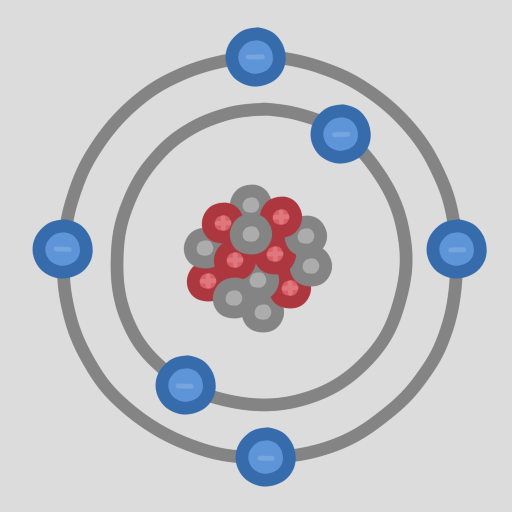
This model, created by James Chadwick, focuses more on the nucleus of the atom instead of its surrounding electrons, unlike many of the models we have seen on this list. This model follows Chadwick’s discovery of the neutron – a particle in the atom with no charge. He describes an atom as having a nucleus that is, in most cases, comprised of both positively charged protons and chargeless neutrons, with negatively charged electrons, orbiting said nucleus in their respective energy levels.
Interestingly, the idea of a neutral particle was first speculated by Rutherford in 1920, and not Chadwick himself. Rutherford thought that a proton and an electron could combine in order to form a neutral particle that shared almost the same weight as a hydrogen atom. He also suggested that these neutral particles would be key to understanding the composition of the nuclei of heavier elements.
So, where does this all leave us today? We’ve seen the atom take on many theoretical shapes and structures throughout the years, including spheres, cubes, clouds, waves, vortexes, and even puddings filled to the brim with irrational, physics-defying fluid! Over the past 222 years, our thoughts on the atom have changed so much, and they continue to change as we continue to delve even deeper into the realm of quantum mechanics. Since Chadwick’s model, we have discovered many more subatomic particles, such as muons, neutrinos, quarks, gluons, and Higgs bosons, which help us to even better understand why the world is the way that it is.
Today, we tend to use a mix of model’s when describing the atom. Our most accepted model, at the moment, is a combination of Chadwick’s nucleus and Schrödinger’s electrons. However, when we first start learning about the atom as children and teenagers, we often use Rutherford’s or Bohr’s model, again with Chadwick’s nucleus, to describe it. Sometimes, schools will talk about older models, such as the Solid sphere model or the Plum pudding model, but it is only ever briefly. I think it such a shame that the rest of this work gets forgotten, that these names and ideas get overshadowed and lost to time. This my effort to keep some of these old ideas alive, and to tell the story of how we got to our model of the atom today.
You can find a list of links to all of the sources used here.
 Natalie's notebook