The plant cipher evolves once again…you’d be disappointed if it didn’t, though, wouldn’t you? Perhaps, when I finally think that I’m finished with it, I’ll make a complete guide to it all.
If you haven’t seen it already, you can find my post that goes into how the bulk of the plant cipher works here. Now, let’s get on with it, shall we?
Using a transposition cipher on top of my plant cipher:
A transposition cipher is a cipher where the contents of a message is rearranged according to a chosen keyword. The components of the message are not changed in any way – just jumbled around. This is done by first creating a table, where each letter of the keyword is assigned to a column. The message is written out, in its original order, in the rows. The new, enciphered message can then rewritten out by the column, according to the alphabetical order of the columns.
Let’s use the keyword ‘Planets‘ with the phrase ‘Dance as the sun slips away.‘ as our example. Here is what the table would look like:
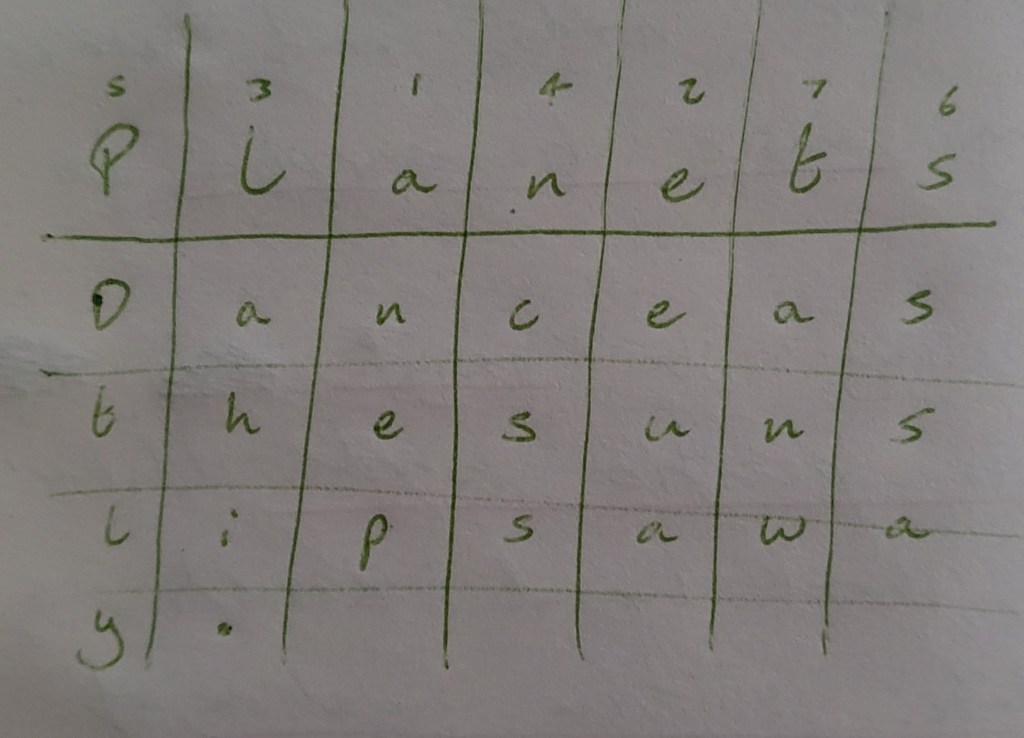
As you can see, I have numbered the columns in the order that the the new message will be written out. As ‘a‘ is the first letter alphabetically, that column gets written out first, followed by ‘e‘, and then by ‘l‘, and so on. This turns ‘Dance as the sun slips away.‘ into ‘nepeuaahi.cssDtlyssaanw‘, using ‘Planets‘ as the keyword.
It’s important to note that if we had used a keyword (or phrase) with repeating letters, such as ‘Acid rain’, then the repeated letters will go in order along the keyword. With ‘Acid rain’, the overall order of the letters would be – A (acid)=1, a (rain)=2, c=3, d=4, i (acid)=5, i (rain)=6, n=7, r=8.
Now, onto the important part – how does this work with the plant cipher? Well first, we need to convert our keyword and message into phonemes:
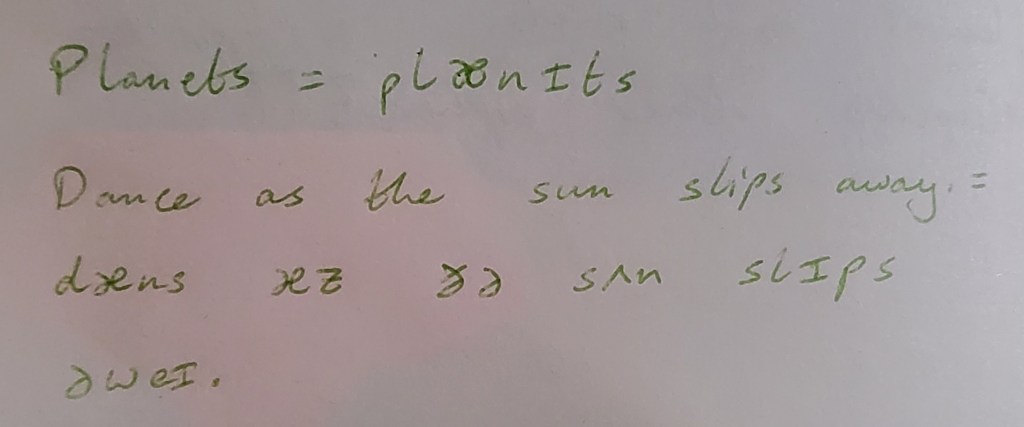
Once we’ve done that, we need to put everything in a table just like we did before. And, in terms of ordering the phonemes in the keyword, I decided to go in the order that I first laid my cipher out in (for simplicity’s sake). This means that the first column is ‘p‘, the seconds is ‘t‘, the third is ‘s‘, and so on.
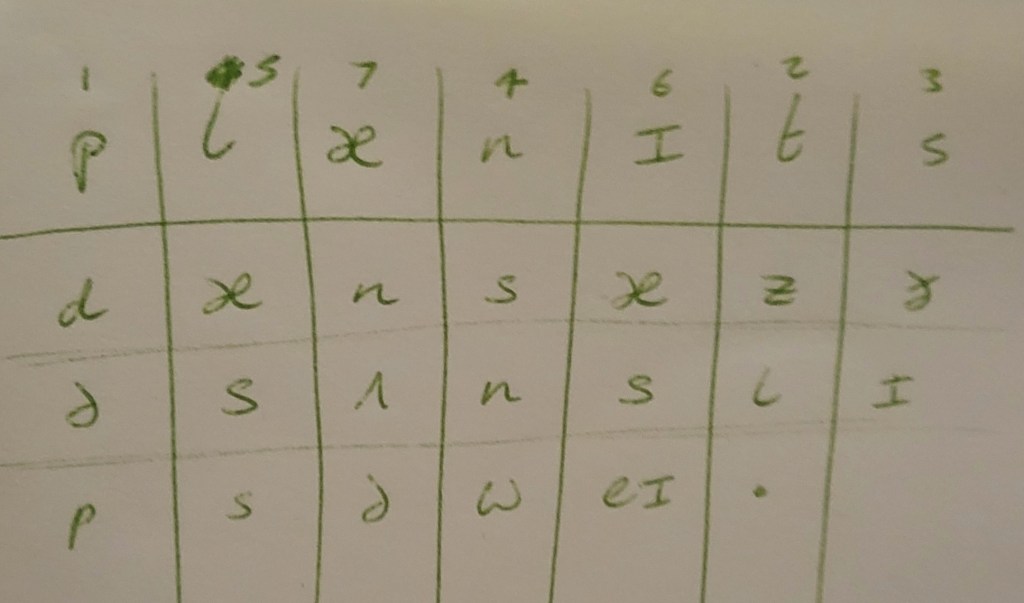
In order to make this work with my cipher, we need to make sure that there is still some kind of structure (unlike the single, long and jumbled ‘word’ that you would normally get). To do this, we need to keep the structure of the plant, the amount of lines (phonemes/punctuation) per leaf, and any berries and leaf/plant modifications the same. So, in this example, the first leaf has 4 lines, the second has 2 lines, the third has 2 lines, etc. I tend to mark this out, in some way, on my table.
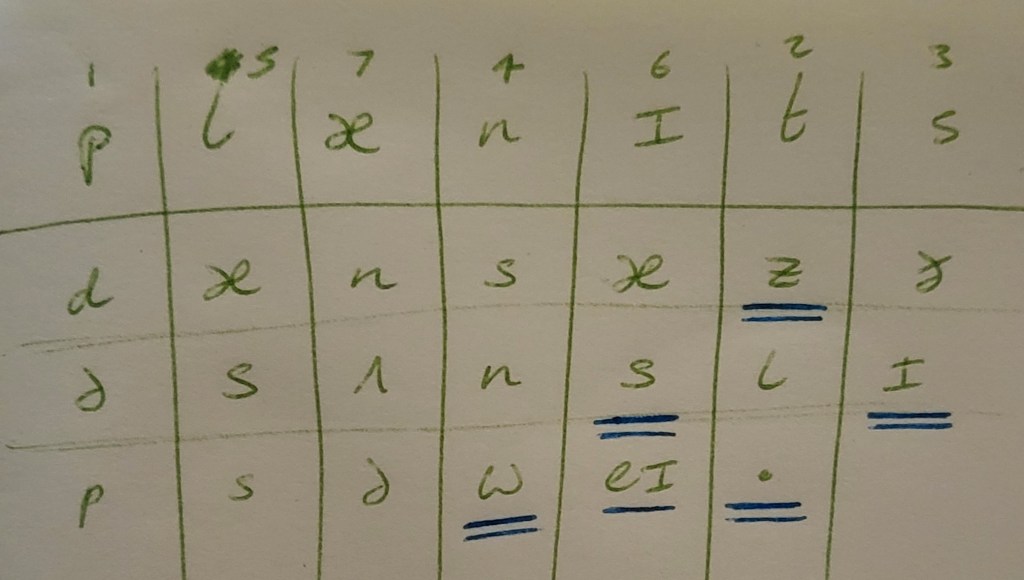
Once you have all of that figured out, you’re ready to draw! It should end up looking pretty similar to a normal piece using the plant cipher.
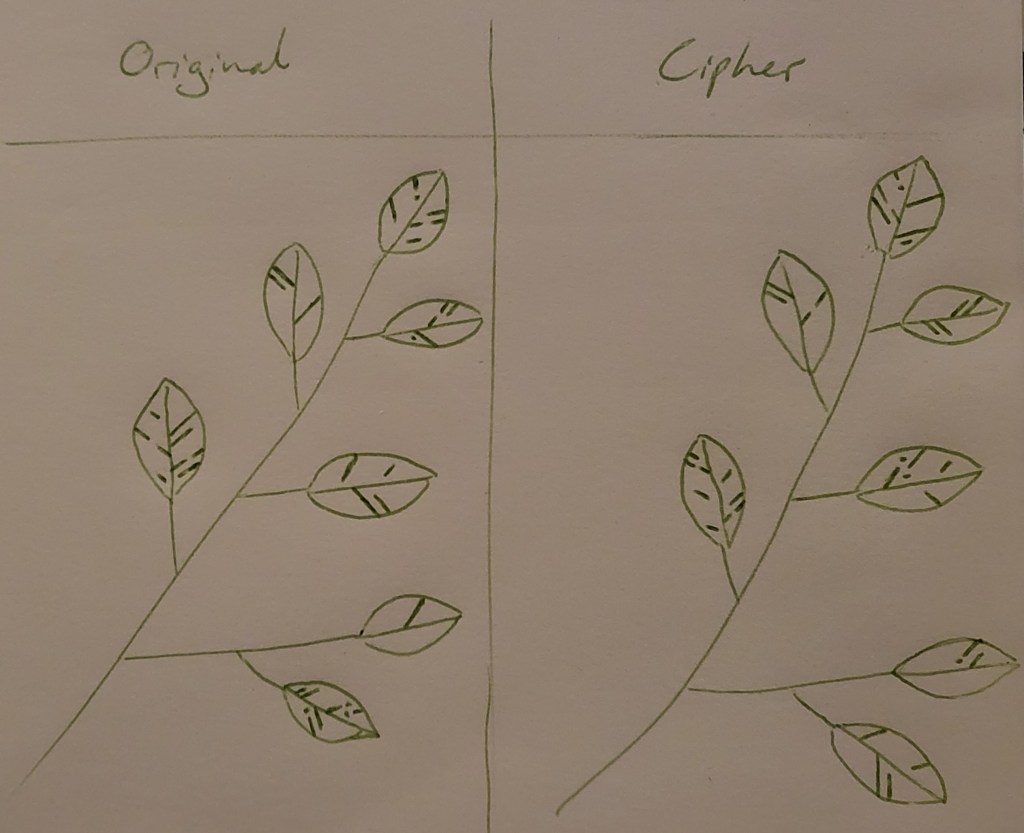
There are, however, a few potential giveaways that can tell you that a transposition cipher has been used on top of the plant cipher:
- Duplicate phonemes – Having multiply of the same phoneme on a single leaf. This only happens normally on rare occasions, but happens a lot more frequently , an in impossible ways, when using a transposition cipher. You can see this in the above example on the fifth leaf.
- Multiple syllable structures – Having phonemes on a single leaf the would normally make up multiple syllables (and, therefore, be across multiple leaves). E.g. ‘enə‘.
- Nonsense punctuation and syllables – Punctuation that is in the completely wrong place and syllable that cannot be realistically pronounced. E.g. ‘!i:n‘ and ‘ftlp‘.
Modifying ‘should’, ‘could’, and ‘would’:
One thing that I had noticed while using my plant cipher is that the words ‘should‘, ‘could‘, and ‘would‘ ended up feeling really clunky when they appeared, particularly when when using leaf mods and berries. To remedy this, I decided to see to try turning these words into some new leaf modifications.
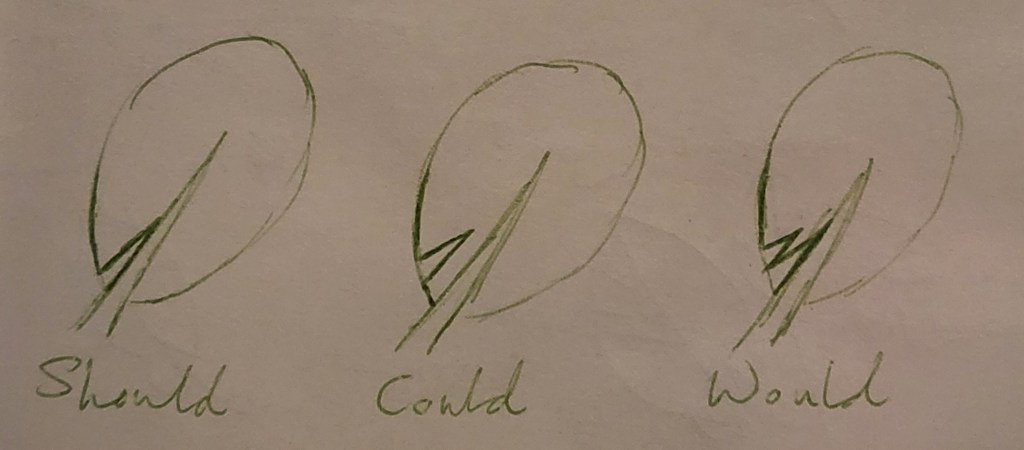
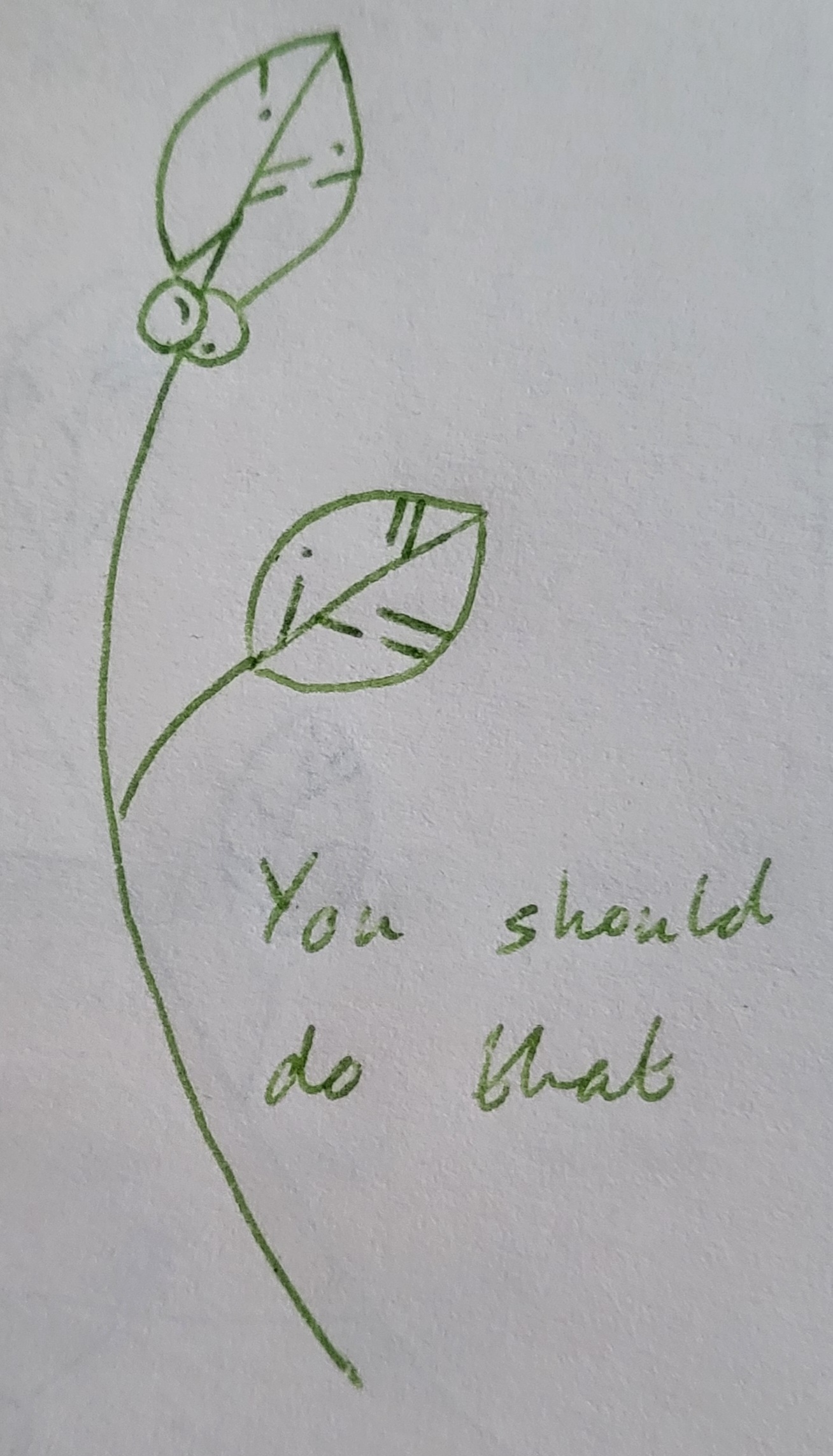
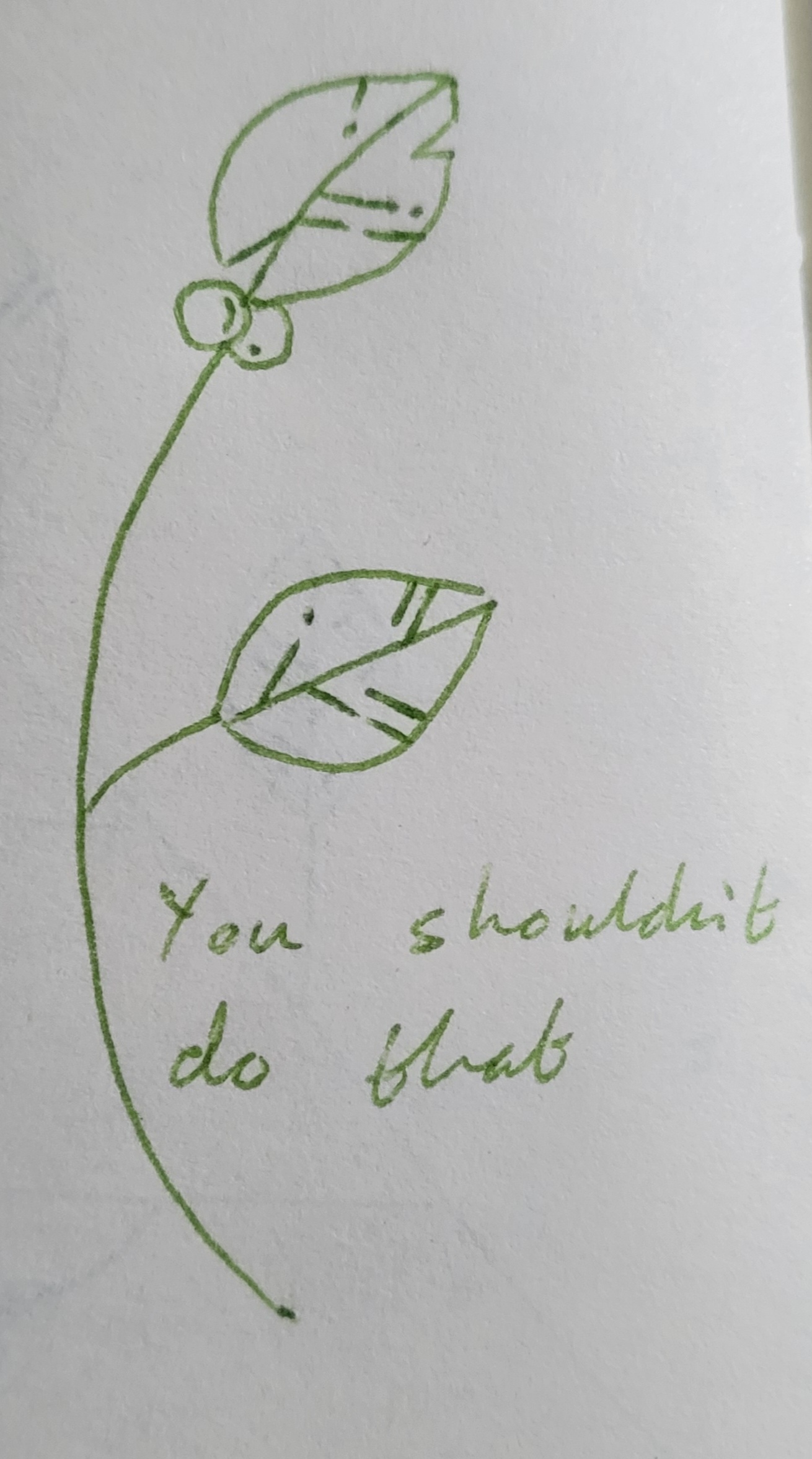
I have since found out that the term for these words is modal verbs, words that are used to express the need or possibility of something happening. I decided to put these leaf modifications on a different part of the leaf to most others, which means that these modifications can easily be used with others if needed, as seen in the examples below.
Adding syllabic emphasis:
This one is a pretty simple one, as it modifies an element that was already a part of the plant cipher. So, what is syllabic emphasis then? Well, when you have a word that is 2 syllables or longer, it tells you which part of the word is emphasised.
We can use the word ‘emphasis‘ as an example, actually. In this word, we emphasise (or stress) the first syllable – emphasis. If we emphasise another syllable, emphasis or emphasis, the word sounds wrong. When you look at how a word is pronounced, where emphasis should be is denoted with an apostrophe – ˈem.fə.sɪs. In my cipher, this is represented with a little creature, perched on the appropriate leaf, with no trail behind it (like there would for generic emphasis across a phrase).
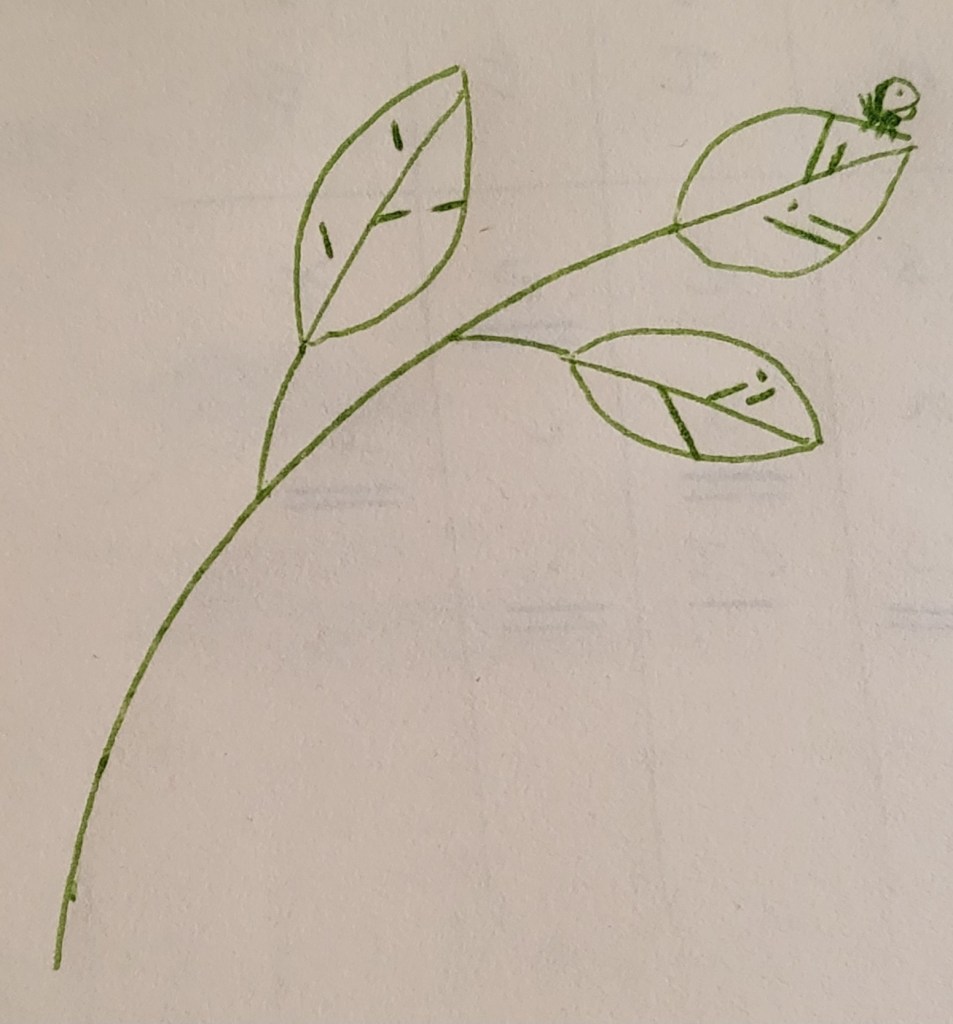
Now, I must confess, this was actually not my idea – it was my brother’s. I showed my cipher to my brother when I saw him over Christmas as he likes to dabble in languages…as in, he thought himself both Welsh and Japanese to the point of fluency just for fun (I could never). Anyway, turns out he was already familiar with the phonetic alphabet that I was using and, having had a flick through my plant cipher book, he suggested adding syllabic emphasis.
Pieces:
#19 – Keyword: Uno:
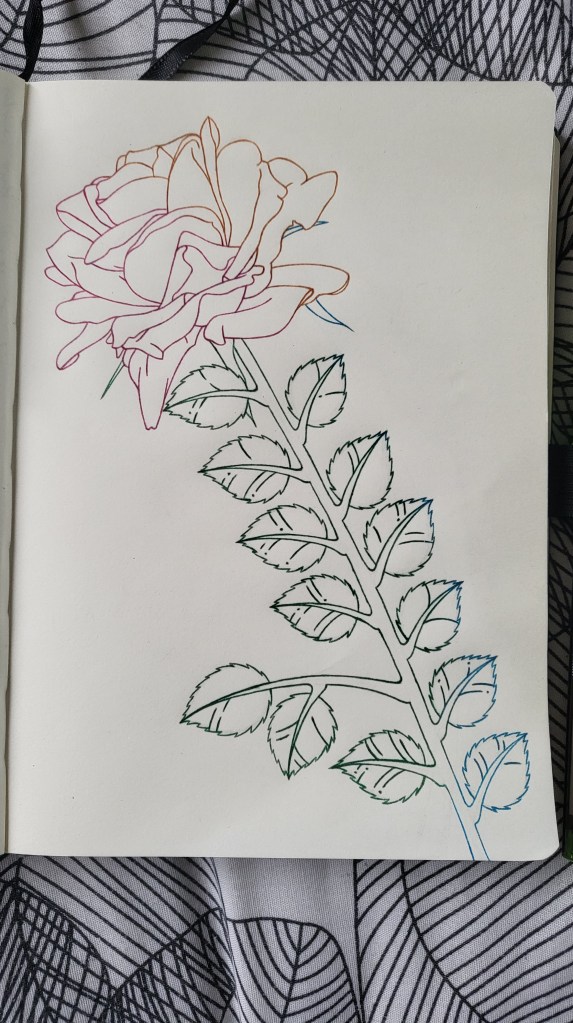
[ You know it’s a good game when the evil laugh comes out. ]
This piece was made while staying at my mum’s house over Christmas (hence the different, yet extremely appropriate, quilt cover) and was my first attempt at using a transposition cipher along with my plant cipher.
For this piece, I wanted to try incorporating a flower again and ended up settling on a rose. I also wanted to mess around with line gradients again, so I the traditional red and green colours of the rose transition into their neighbouring colours on the colour wheel (orange and blue, respectively). This transition of colours was also intended to tie in with the transposition cipher itself, with the idea of things being shifted around, but I’m not sure how well this comes across.
In terms of the message and keyword themselves, they were merely spawned from a phone call. I was on the phone to my best friend and her and her boyfriend were playing Uno. Not just any Uno, however, this was ‘Uno: No mercy’. They’d already been playing for about 45mins before our call started, and they finally decided to end the round over an hour after our call began – calling it a draw. While they had playing, her and her boyfriend had been sporadically cackling, leading to the message and keyword of this piece.
#20 – Keyword: Meowing:
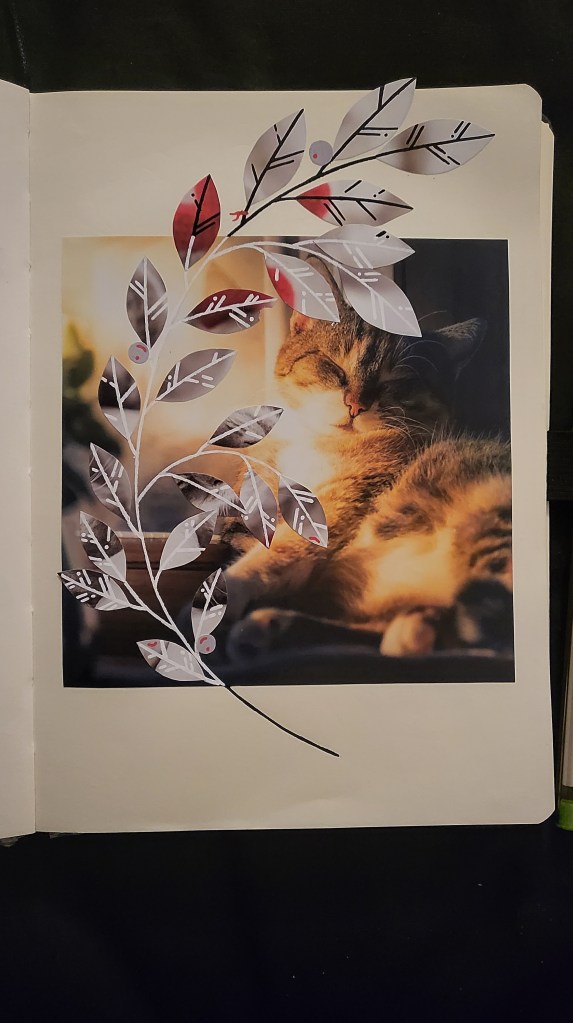
[ This was last year’s calendar. The leaves are made of February and the background is June. ]
Every year, for Christmas, my mum will buy me a new cat calendar. It’s a tradition, at this point, and I didn’t want last year’s calendar to go to waste. It had some really nice images, and I didn’t just want to bin them; so, I reused some of them. The message says it all, really.
The piece also uses a transposition cipher but, this time, with addition of berries and leaf modifications, and I quite like how it turned out. The pictures used end up forming a really nice and warm colour pallet, and the unintentional decreasing leaf size as you go down the stem is quite subtle. I also tried using some paint pens for the details – which worked rather well too. Overall, a cute piece. You really can’t go wrong with a cat, can you?
#21 – Keyword: Landfill:
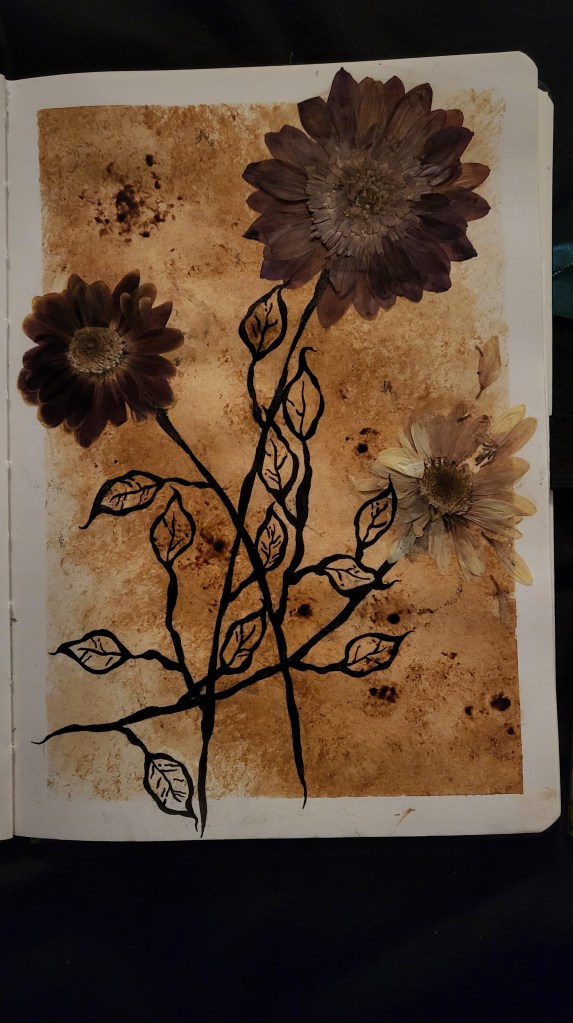
[ Your irises have roots before they hit the ground. ]
This piece, again, uses a transposition cipher on top of my plant cipher. It contains a lyric from the song Into a landfill by Little red lung and is a combination of real flowers, a brush pen, and shit coffee. This piece is primarily based around wanting to use some of the flowers that I had pressed.
The flowers of this piece came from a bouquet that I got from work. When they were starting to look a little worse for wear, in their pint glass vase atop the oven, I decided to harvest some of the leaves and flowers and press them. I hadn’t pressed any flowers in quite a while, and these ones took a bit longer than expected and didn’t really keep any of their colour as I had hoped. All but one of the flowers turned brown, but I was still determined to use them instead of throwing them away. That was when I know what the background was going to made from.
The background was painted with the same coffee that I used in a prior piece – the one that tastes awful and smells like burning plastic. Not only was this a fitting shade of brown to go with the flowers, it’s something that I, similarly, almost threw away. It was at this point that I decided what the message of the piece would be.
As for the for details of the piece, these were done with a brush pen. Honestly, I forgot that I had one and found it buried at the bottom a pencil case. I hadn’t used it in ages and decided to give it another go, as I remembered not being very good with it before…hence its lack of use. I tried deliberately using different line weights and to make the lines shaky and ‘imperfect’. I even decided to test if I could make the leaf lines a bit squiggly and still have them be legible, which I think I did quite successfully!
Overall, I am very pleased with this piece – made of things that almost landed in the bin. Although, one thing that I have learned from this piece is that a thick layer of coffee-paint ends up being pretty shiny and quite tricky to draw on.
#22 – Look at the pretty colours…:
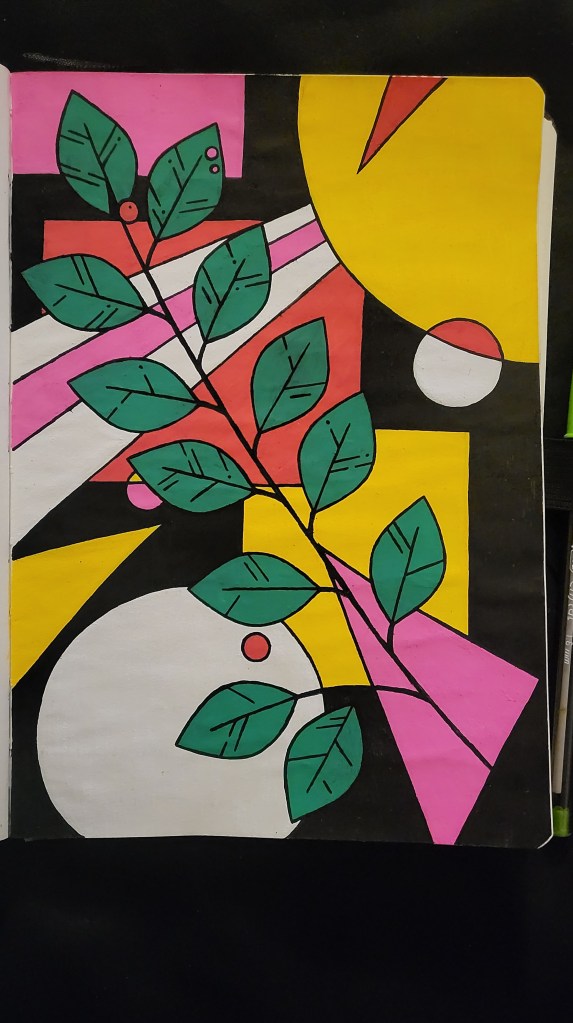
Should I keep going? Some days it is hard to know the answer.
I kind of went ham with the paint pens on this one…but I also kind of love it. It was my first go at doing anything in a pop art style and, I think, it turned it really well! It’s bright and colourful and all of the leaves are delightfully proportional. The latter is thanks to the use of a stencil – which was made out of a small post-it note. I had never tried using one for my leaves before, but I would certainly try using one again (especially if it was a more complex leaf design).
I did actually make one big mistake in this piece; I miscounted my leaves and added 2 extra ones by accident. I only realised that I did this after I had already coloured them all in. I really didn’t feel like colouring over them (with multiple layers of paint), redrawing the background, and fixing my mistake. So, I worked with the mistake instead. The question at the start remained the same, as I wanted to keep the new ‘should’ leaf mod., but the second sentence was simplified and stretched out so I could use the 2 extra leaves. To do the this, ‘it’s’ became it ‘it is’ and ‘to’ was written with lines instead of being a berry. As it happens, with the latter, it almost looks as though the berry has fallen off of the leaf. This was unintentional, as I completed the background prior to laying out any of the leaves (and I only really noticed this while writing up this post).
#23 – Avantasia:
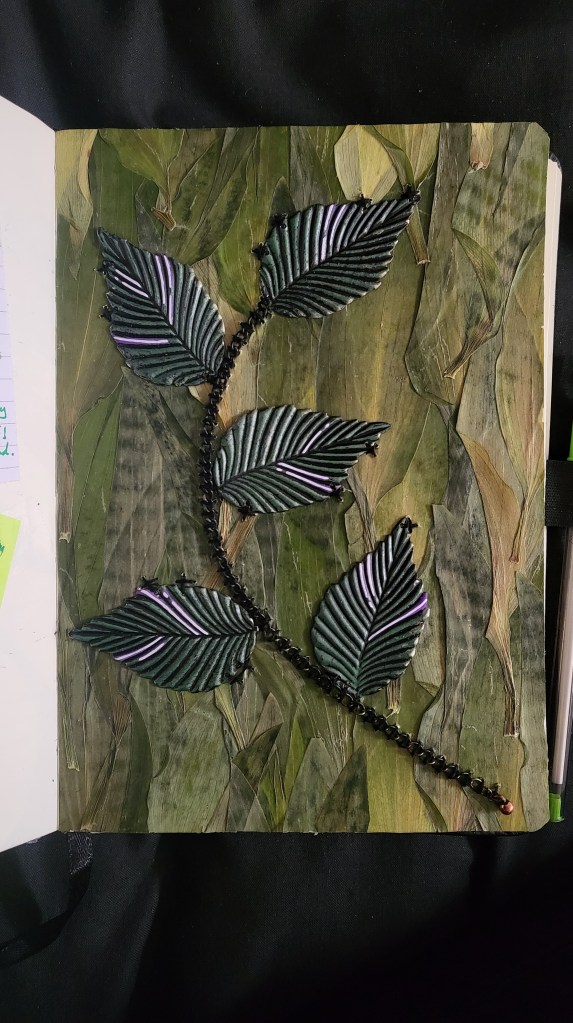
Avantasia
Believe it or not, this piece started off as a necklace from a charity shop. The moment that I spotted it, I just knew that I had to make a piece with it. I wracked my brain for quite a while, trying to decide what to write with just 5 leaves at my disposal. Then, I went to go and see a band at the Roundhouse and my decision was made. Tobias Sammet’s Avantasia it was.
Honestly, this isn’t my finest work. My favourite thing about the whole piece is the background, which is made of real leaves (acquired from a reduced bouquet in Lidl and pressed). It’s just not as legible as I had hoped it would be, although the arrangement of things isn’t too bad. In order to achieve this middling piece, I glued down a bunch of leaves, reinforced the back, and then sewed the harvested necklace parts to the page.
It was an amazing gig, though. Toby was really good at hyping up the audience and making us all laugh, the set was 3 hours long (with a total of 22 songs) and absolutely fantastic, and they set a grand piano on fire near the end. I just hope it doesn’t take them another 6 years to come back to the UK…
#24 – Truely, a miracle:
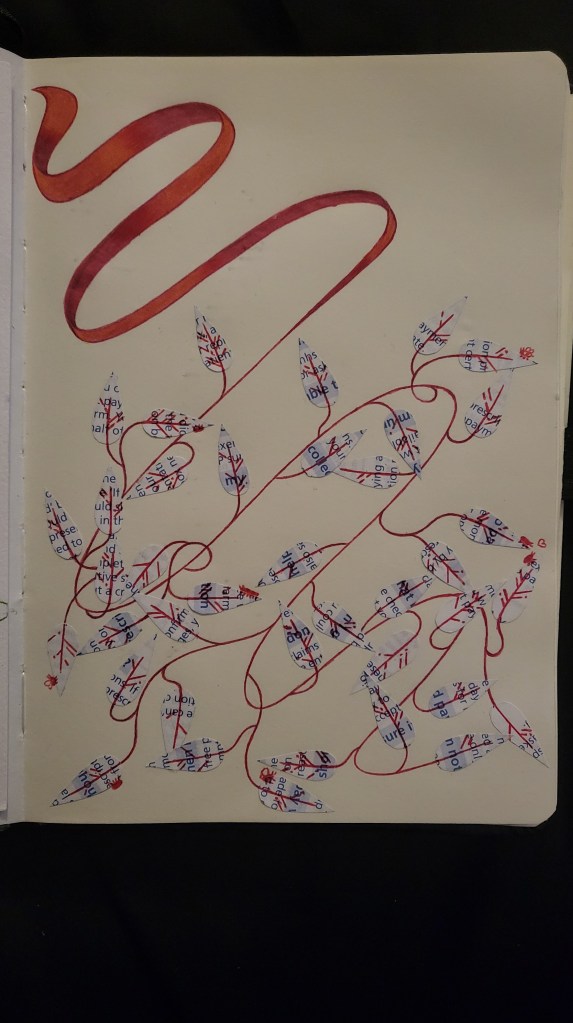
Oh my God, I can’t believe it! I got taken seriously by a doctor! I am being sent for a nerve conduction study and am trialling some meds.
I first remember noticing that something was wrong with my feet when I was about 11, and for the past few years I have had a strong suspicion that I have a problem with my nerves, as it has started affecting my hands too (my suspicion being SFN, in case anyone is interested). I have tried a few times in the past to get it sorted out, but most of the time got brushed off. I have twice been given orthotics that don’t work, I’ve been given stretches to try, and I have been told to take OTC pain relief that I had said during that very same appointment does nothing.
Recently, I’ve been trying to get myself some help again. And finally, a few weeks ago, I got listened to. That felt nice…and quite overwhelming. I managed to see a doctor, after already having had some bloods done, and he ended up having similar suspicions to me – with it probably being a nerve thing. He ended up referring me for x-rays (which I had done earlier this week) and a nerve conduction study (which I have yet to have). In the meantime, he prescribed me a low dose of antidepressants to try, to see if they would help. It’s safe to say that I had not been expecting all of that from a single appointment, hence this piece. The leaves are cut from the bit a of paper that you get with prescriptions in the UK. Even though this may not be my favourite piece, it’s proof that I got believed. That’s enough for now.
Also, this piece was a good one to show off syllabic emphasis.
Well, that got surprisingly personal at the end, didn’t it? I didn’t really mean for that to happen but it’s there now, I suppose.
Anywho, it’s song time! Today’s album is some energetic, goblin-themed metal! So, please enjoy Welcome to Bonkers by Nekrogoblikon
Here’s a little bonus thing for you! Well, for those who got this far, anyway. As I think I may have mentioned before, all of my pieces are contained within a single notebook. But it doesn’t just contain all of the pieces, it also contains all of the cipher’s development, experimental things and trialled ideas, and all of the working out and planning for each piece. In my head, I simply refer to this as ‘my plant cipher book’ and it is, in my opinion, becoming what all good art books should be – chunky. It also occurs to me that you’ve never seen it as a whole entity before. So, here it is. I’m just under 2/5 of the way through and it has already doubled in size!
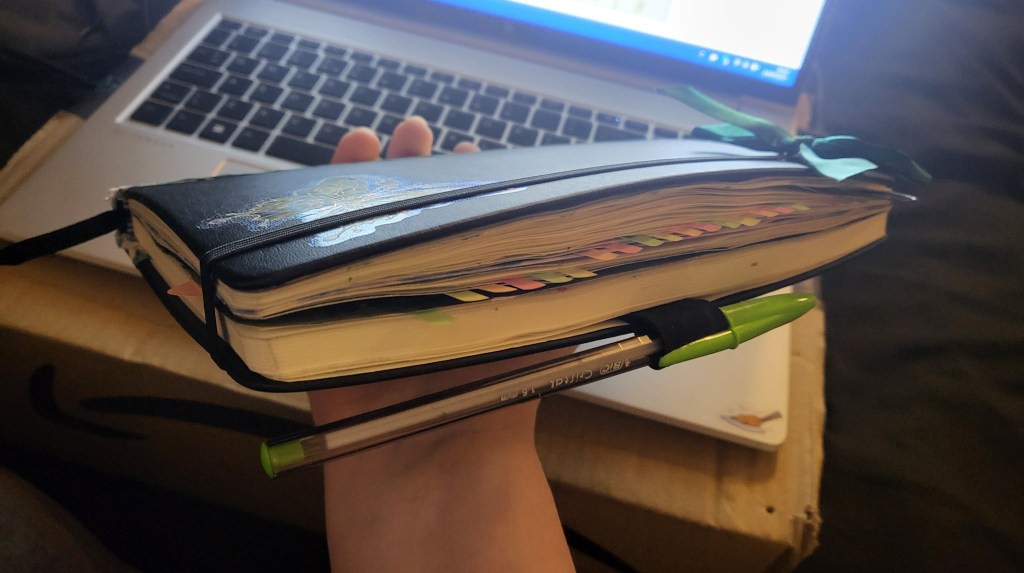
It’s certainly a well-loved book. It’s cover is warped from vein attempts to close, the decoration on its spine is peeling away at the bottom corner and fading in parts, and the elastic is adorned with one of many bows gifted to me by my best friend (which she harvested from her Christmas celebrations last year knowing that I would find some kind of use for them all eventually).
The colourful tabs on the side each mark a piece – all 24 of them that I’ve shown off so far. As for the post-it note on at the bottom, that marks the page of ideas for what I want to do next. Some ideas are completely new, but others are things that I’ve tried before that didn’t quite work the first time. We’ll see what we can do. I think it will be fun.
Lastly, here’s fun little fact – I completed my first piece on 19/04/2024. It has been 1 year since this all began! I didn’t think that I had been working on this for so long. Where the hell did that year go?
 Natalie's notebook