By Natalie Peirce
PLEASE NOTE THAT, HAVING REVIEWED THIS PIECE AT A LATER DATE, I BELIEVE THAT SOME ELEMENTS ARE NOT FACTUALLY ACCURATE. READ AT YOUR OWN DISCRETION. – 25/06/2025
Sex chromosomes are the chromosomes that determine an individual’s biological sex, i.e. whether an individual is biologically male or female. In humans, this done with the X and Y chromosomes. When a person has 2 X chromosomes (XX), they are biologically female, and when a person has an X and a Y chromosome (XY), they are biologically male. [1]
Now, it’s a fairly common misconception that the Y chromosome is just an X chromosome that is missing a few pieces, but this is not the case. While, in humans, the 2 chromosomes do have some genes in common, the majority of DNA on the Y chromosome is completely unique when compared to that of the X chromosome. [2] In fact, this unique DNA is often used in paternity and forensic cases to tell the difference between different males. [3] Even the genes that the X and Y chromosomes share, such as amelogenin, are a bit different from each other and can also be used forensically to see whether a DNA sample is from a male or a female. [4]
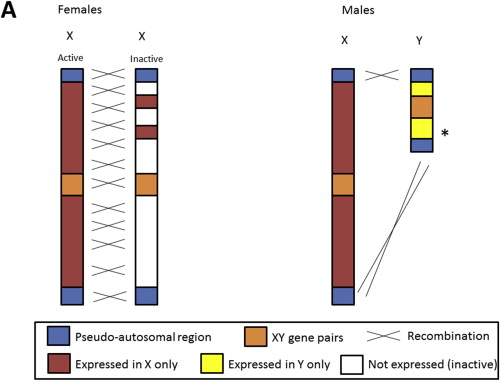
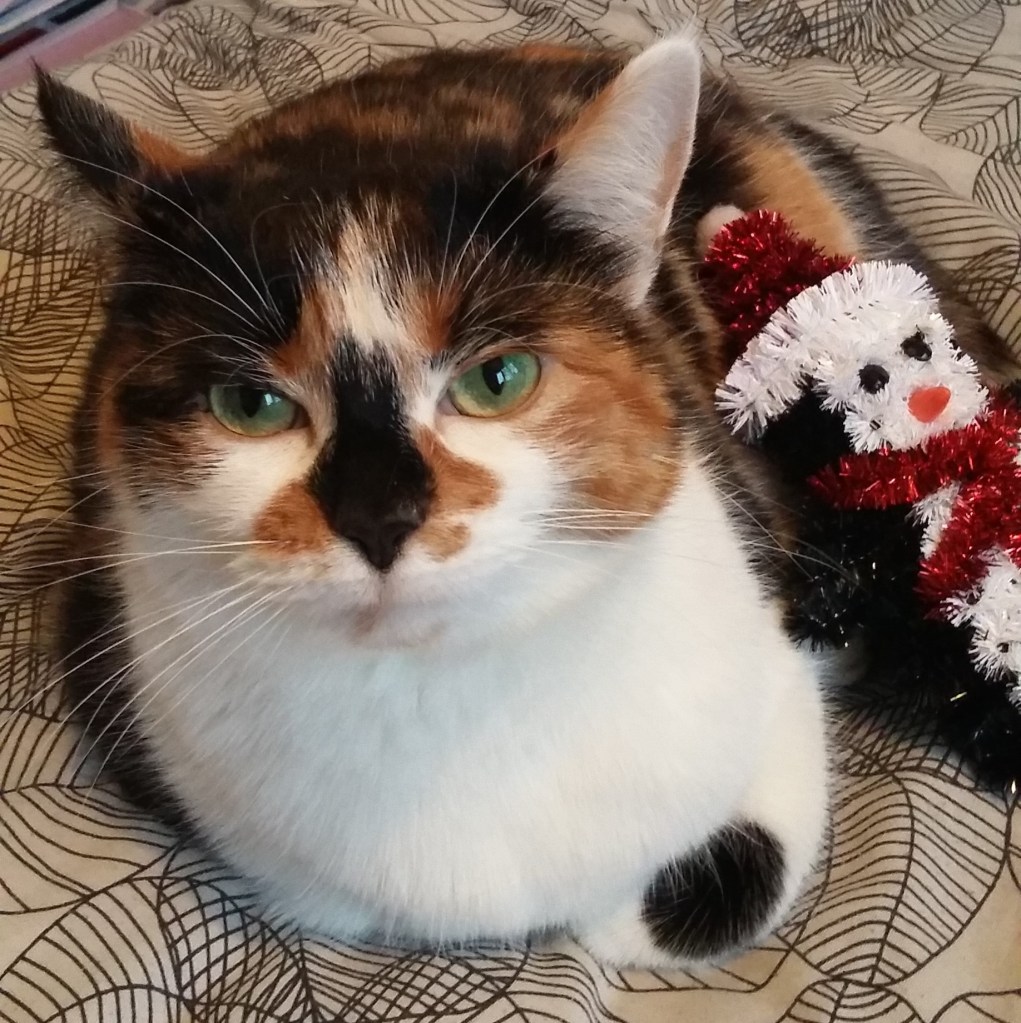
The X chromosome itself is also quite interesting. More specifically, it does something quite interesting when a person has 2 of them. During the early development of female embryos, most the of the genes on 1 of their X chromosomes are inactivated, i.e. turned off. This happens randomly in every cell and that chromosome then stays inactive as the cells divide and become specialised. [6] This X inactivation doesn’t just happen in humans, but other mammals too, and can be clearly seen in tortoiseshell cats. This is because the orange and black colours of a cat’s fur are determined by a gene on their X chromosomes. Therefore, if a cat has 2 X chromosomes, and 1 results in black fur and the other results in orange fur, it creates a tortoiseshell cat – a cat that has a mix of orange and black fur, as only 1 of the fur colour genes is active in each cell. [7]
Sometimes, humans and other mammals are born with either extra or missing sex chromosomes. This often affects sexual development, decreases fertility, and can cause a variety of other symptoms depending on what chromosomes they have. Some examples of this include Turner syndrome (X), Triple X syndrome (XXX), and Klinefelter syndrome (XXY). [8][9][10]However, there are some mammals that have evolved to intentionally have more than 2 sex chromosomes. An example of this is the duck-billed platypus, which has 10 sex chromosomes instead of just the 2. [11]
Curiously, X and Y chromosomes aren’t the only chromosomes that are used to determine and individual’s sex. In birds, Z and W chromosomes are used instead. These work a bit differently to X and Y chromosomes, as females have a Z and a W chromosome (ZW) and males have 2 Z chromosomes (ZZ). [12]
Insects tend to have a mix of both X and Y chromosomes and Z and W chromosomes, depending on the species. For example, some species of fleas (Siphonaptera), springtails (Collembola), and mayflies (Ephemeroptera) have X and Y chromosomes just like humans do, and some species of butterflies and moths (Lepidoptera) have Z and W chromosomes just like birds do. Sometimes, insect species will only have 1 kind of sex chromosome, and the amount that they have of that 1 chromosome will determine their sex. In the case of cockroaches (Blattodea) and some beetles (Coleoptera), the females will have 2 X chromosomes (XX) and the males will only have 1 (XO). And, in the case of caddisflies (Trichoptera) and some butterflies and moths, the females only have 1 Z chromosome (ZO) and the males will have 2 (ZZ). Additionally, some insect species, such as some fleas and beetles, will use multiple sets of chromosomes to determine their sex. [13]
There is 1 more, surprisingly common (yet rarely mentioned), type of sex chromosomes – U and V chromosomes. These chromosomes are present in many species, including mosses and algae. In this system, females have a U chromosome and males have a V chromosome. [14]
So, as you can see, an individual’s sex can be determined in a multitude of different ways with a variety of different chromosomes. There are also other ways to determine, or even change, an organism’s sex outside chromosomes, such incubation temperature [15] or social pressures. [16] Some organisms even have more than 2 biological sexes, such as tetrahymena which have 7! [17] But that’s enough about sex today – I think I’ll just stick with my 2 X chromosomes. Nice and simple (sort of).
References:
- THE EDITORS OF THE ENCYCLOPAEDIA BRITANNICA (2024) Sex chromosomes [Online] Britannica. Available from: https://www.britannica.com/science/sex-chromosome
- SKALETSKY, H. KURODA-KAWAGUCHI, T. MINX, P. et al. (2003) The male-specific region of the human Y chromosome is a mosaic of discrete sequence classes. Nature 423, 825–837.
- GUSMÃO, L. BUTLER, J.M. CARRACEDO, A. et al. (2006) DNA Commission of the International Society of Forensic Genetics (ISFG): an update of the recommendations on the use of Y-STRs in forensic analysis. International Journal of Legal Medicine 120(4),191–200.
- ELMRGHNI, S. (2023) Role of Amelogenin in Human Identification. Annals of Clinical and Medical Case Reports. [Online] 11 (14). Available from: https://acmcasereport.org/wp-content/uploads/2023/11/ACMCR-v11-2035.pdf
- WINHAM, S. ANDRADE, M. and MILLER, V. (2015) Genetics of cardiovascular disease: Importance of sex and ethnicity. Atherosclerosis. [Online] 129 (1). Available from: 10.1016/j.atherosclerosis.2015.03.021
- NESTEROVA, T.B. POPOVA, B.C. COBB, B.S. et al. (2008) Dicer regulates Xist promoter methylation in ES cells indirectly through transcriptional control of Dnmt3a. [Online] Epigenetics & Chromatin 1(2). Available from: https://link.springer.com/article/10.1186/1756-8935-1-2
- AHN, J.Y. and LEE, J.T. (2008) X chromosome: X inactivation. [Online] Nature education 1 (1). Available from: https://www.nature.com/scitable/topicpage/x-chromosome-x-inactivation-323/
- NHS (2021) Overview: Turner syndrome [Online] NHS. Available from: https://www.nhs.uk/conditions/turner-syndrome/
- MAYO CLINIC STAFF (2022) Triple X syndrome [Online] Mayo Clinic. Available from: https://www.mayoclinic.org/diseases-conditions/triple-x-syndrome/symptoms-causes/syc-20350977
- NHS (2023) Klinefelter syndrome [Online] NHS. Available from: https://www.nhs.uk/conditions/klinefelters-syndrome/
- RENS, W. GRÜTZNER, F. O’BREIEN, P.C.M. et al. (2004) Resolution and evolution of the duck-billed platypus karyotype with an X1Y1X2Y2X3Y3X4Y4X5Y5 male sex chromosome constitution. Proceedings of the National Academy of Sciences. [Online] 101 (46). Available from: https://www.pnas.org/doi/10.1073/pnas.0405702101
- NAMEKAWA, S.H. and LEE, J.T. (2009) XY and ZX: Is meiotic sex chromosome inactivation the rule in evolution? PLoS Genetics. [Online] 22 (5). Available from: https://pmc.ncbi.nlm.nih.gov/articles/PMC2679206/
- TRAUT, W. (1999) The evolution of sex chromosomes in insects: Differentiation of sex chromosomes in flies and moths. European Journal of Entomology 96, 227-235.
- COELHO, S.M. GUENO, J. LIPINSKA, A.P. et al. (2018) UV chromosomes and haploid sexual systems. Trends in plant science [Online] 23 (9). Available from: https://pmc.ncbi.nlm.nih.gov/articles/PMC6128410/#:~:text=When%20sex%20is%20determined%20genetically,males%20carry%20a%20V%20chromosome.
- MARTÍNEZ-JUÁREZ, A. and MORENO-MENDOZA, N. (2019) Mechanisms related to sexual determination by temperature in reptiles. Journal of Thermal Biology [Online] 85. Available from: https://www.sciencedirect.com/science/article/abs/pii/S0306456518304170
- CASAS, L. SABORIDO-REY, F. RYU, T. et al. (2016) Sex change in clownfish: Molecular insights from transcriptome analysis. Scientific Reports [Online] 6. Available form: https://www.nature.com/articles/srep35461
- UMEN, J.G. (2013) Genetics: Swinging Ciliates’ seven sexes. Current Biology [Online] 32 (11). Available from: https://www.sciencedirect.com/science/article/pii/S0960982213004442#:~:text=After%20mating%20each%20new%20exconjugant,to%20seven%20possible%20mating%20types.
 Natalie's notebook