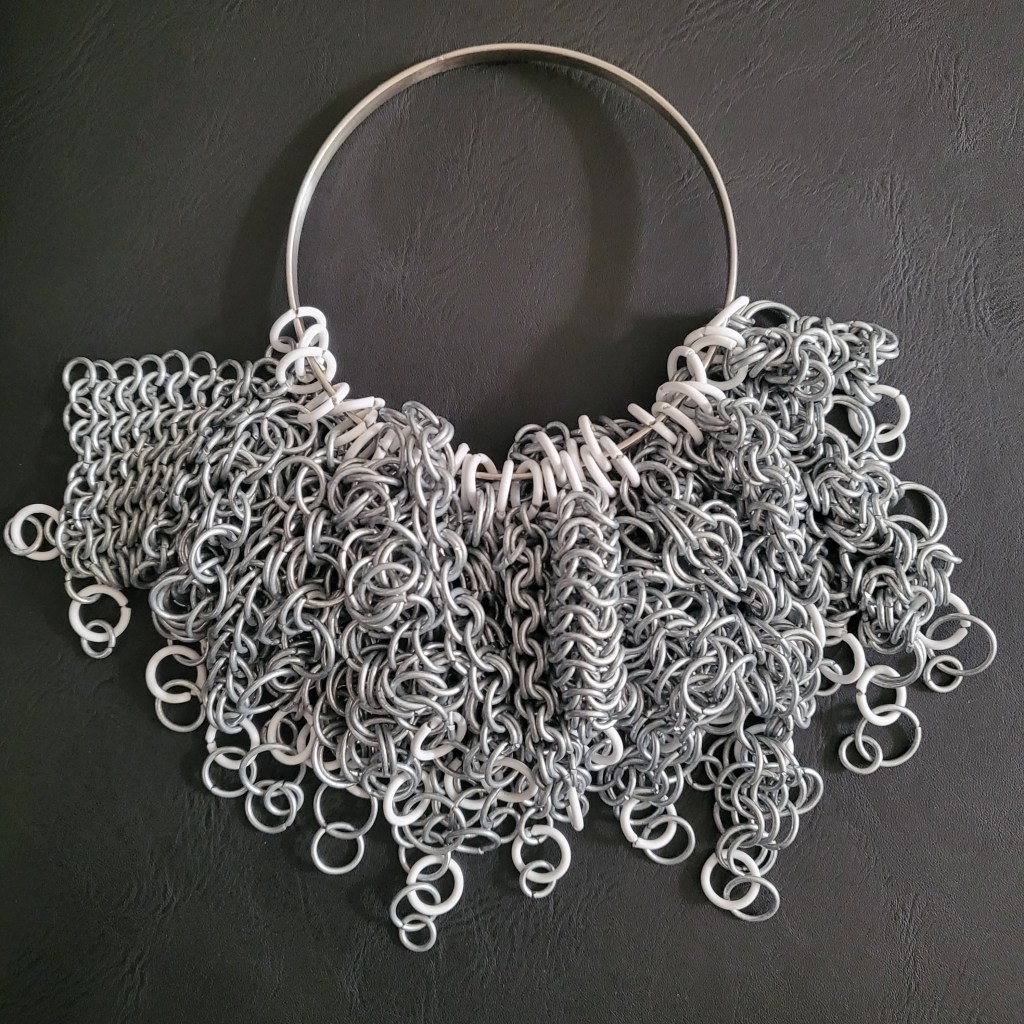
About the sample ring:
It is a ring (in this case, a cheap bangle from Amazon) that contains a bunch of different chainmail weaves. Every time I learn to make a new weave, it gets added to the ring and I can then use it as a reference later – either to get a good idea of what the weave may look like for a project or to figure out how to make the weave again (if I forget). So far, there are 32 different weaves on the ring.
Despite what it may look like, my sample ring is actually quite well organised. I have grouped each of the weaves, as best as I can, by their base weaves. There is a bit of crossover for some weaves as some have multiple base weaves, but I have tried to put them where I think they fit best on the ring. So far, there are 9 different groups- 2-in-1, European, Persian, helm, Japanese, mobius, inverted round, box, and Byzantine.
The rings used for each weave are made from steel wire with a 1.1mm diameter. The aspect ratio (AR) of the rings will vary from weave to weave depending on what the weave requires. Generally, I try to use the smallest AR that I can for the weaves (with the rings that I can make, of course).
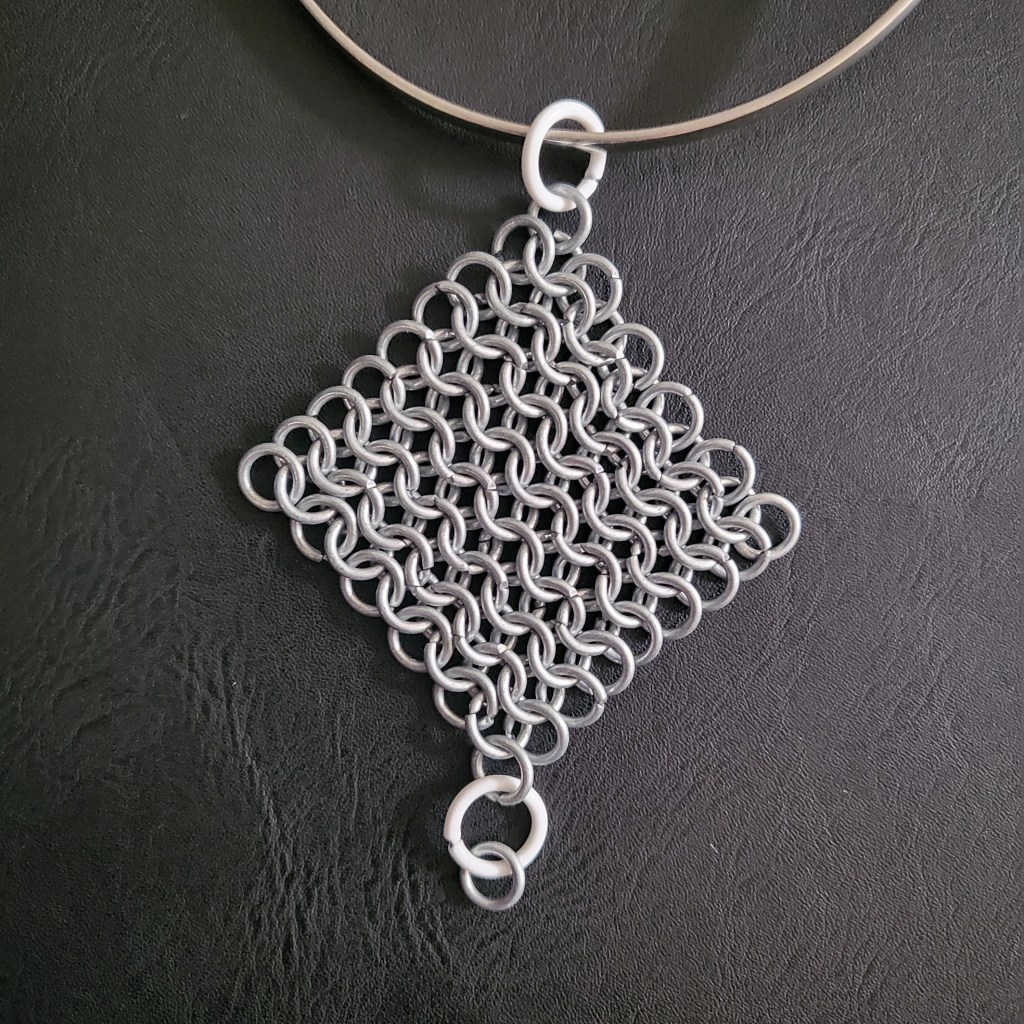
Each weave is connected to 2 white rings with an AR of 4.3, which are made from PVC coated wire with a diameter of 1.4mm. This is mostly because I made a bunch of them and then didn’t know what to do with them…so I used them for this. These rings are attached to opposite ends of the weave and one connects the weave to the bangle while the other attaches an extra ring(s) to more clearly show which ring(s) was used in the weave, as pictured above. I also find that using these white rings help me to distinguish which rings are a part of the weave and which are not.
The weaves so far:
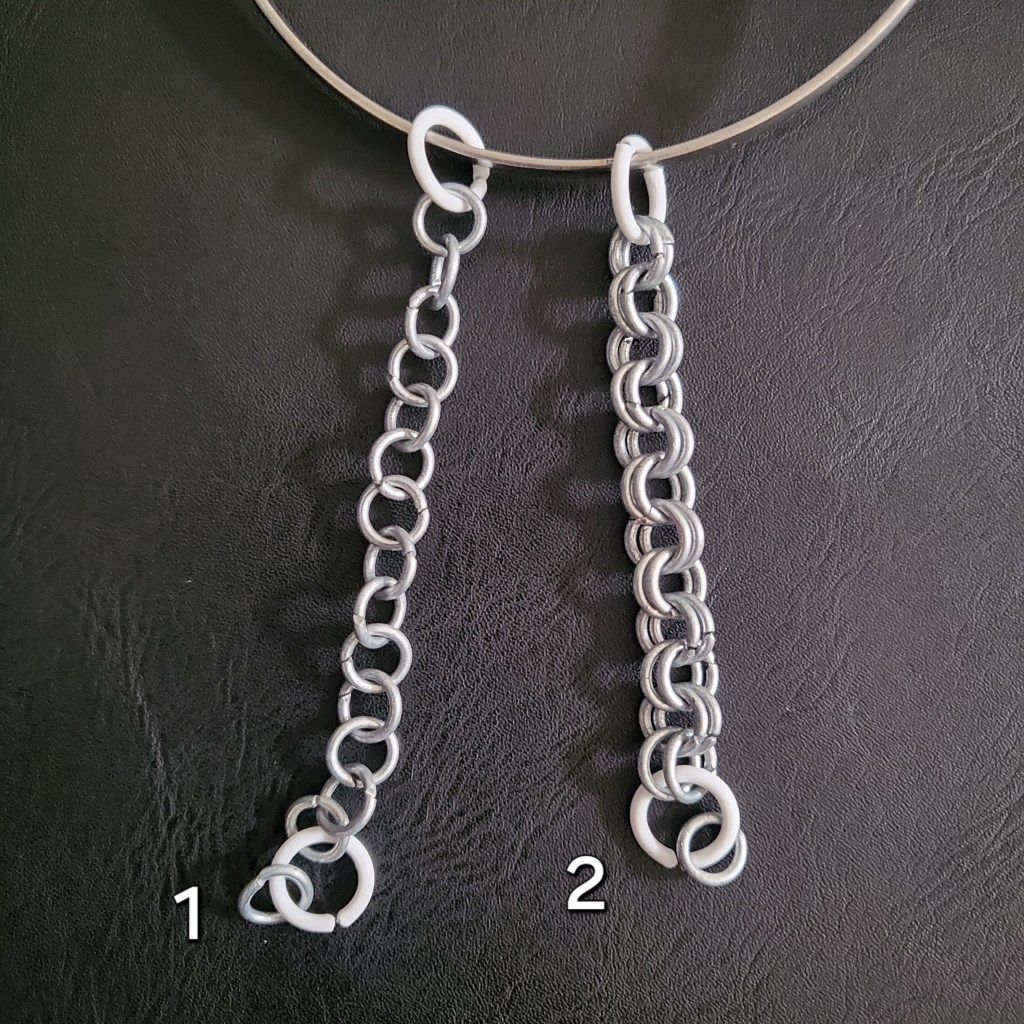
1 – 2-in-1 – The simplest weave in chainmail. It can be done with a very small AR (much smaller than the one pictured here) and still keep its flexibility.
2 – 4-in-2 – Another very simple weave that can be done with a small AR. I use this one quite a lot when I make jewellery for the chain that my hooks go into (I find it looks a lot neater than 2-in-1).
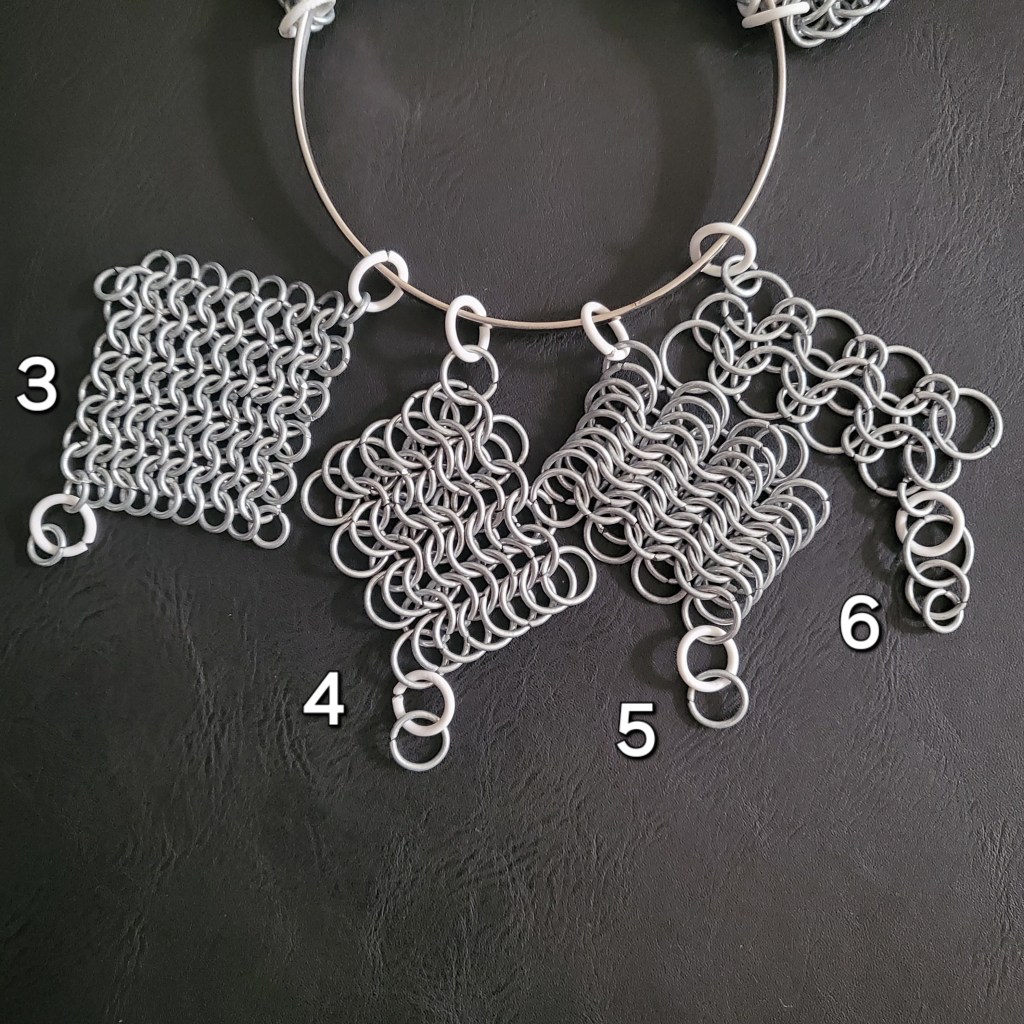
3 – European 4-in-1 – The first chainmail weave that I ever tried making and what most people think of when you say chainmail. It is yet another simple weave.
4 – European 6-in-1 – Very similar to the weave above, except that a single ring connects to 6 other rings instead of 4. As a result, it requires a higher AR.
5 – European 8-in-1 – Again, similar to the 2 weaves above, except that a single ring connects to 8 other rings.
6 – Supersonic waves – An adaptation of European 4-in-1 that uses rings of varying ARs to distort the weave a bit – resulting in triangular shapes.
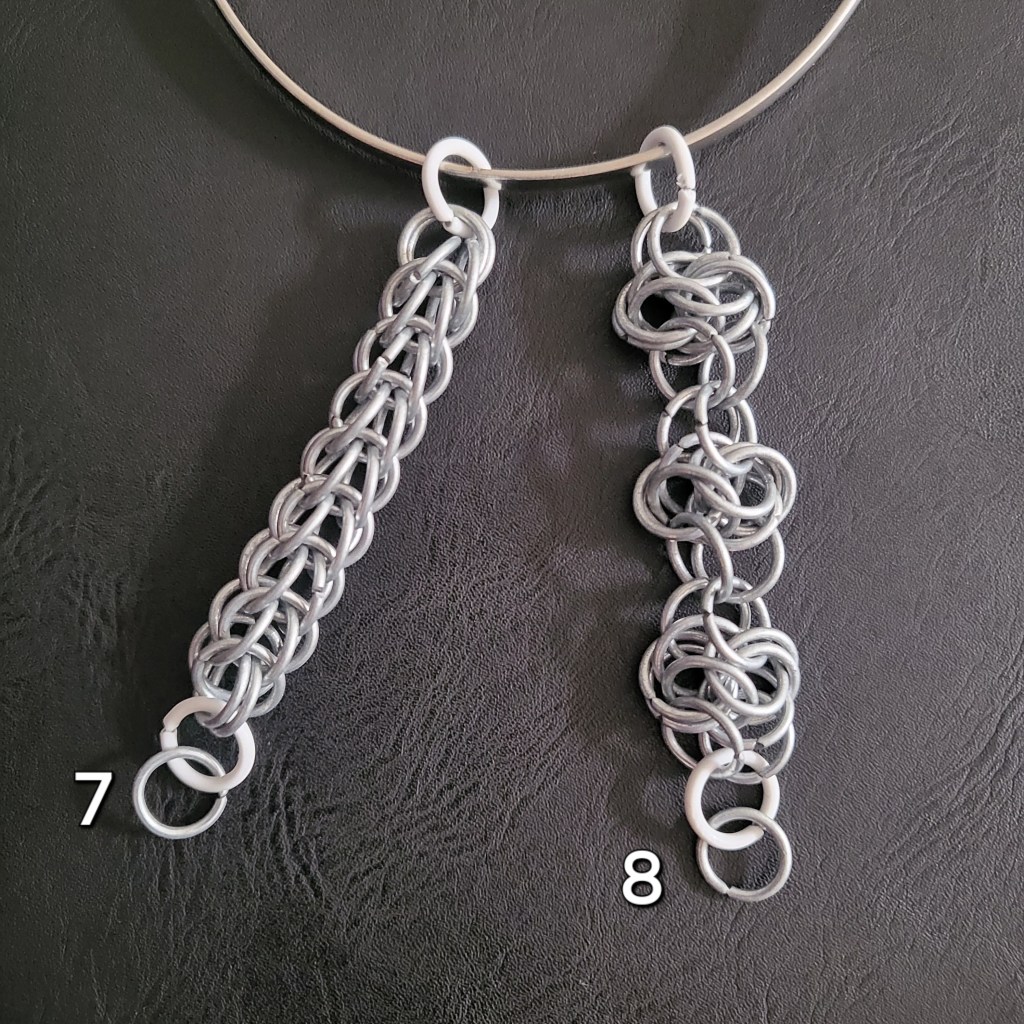
7 – Full Persian 6-in-1 – This is the second chainmail weave that I ever tried and it is a long-standing favourite. Simple, but effective.
8 – Full Perian ladder – Uses smaller full Persian 6-in-1 units (made of 12 rings each) to make a chain. This weave can be a little tricky to wrap your head around, but as long as you check that everything is flipped and folded the right way, then you’ll be fine.
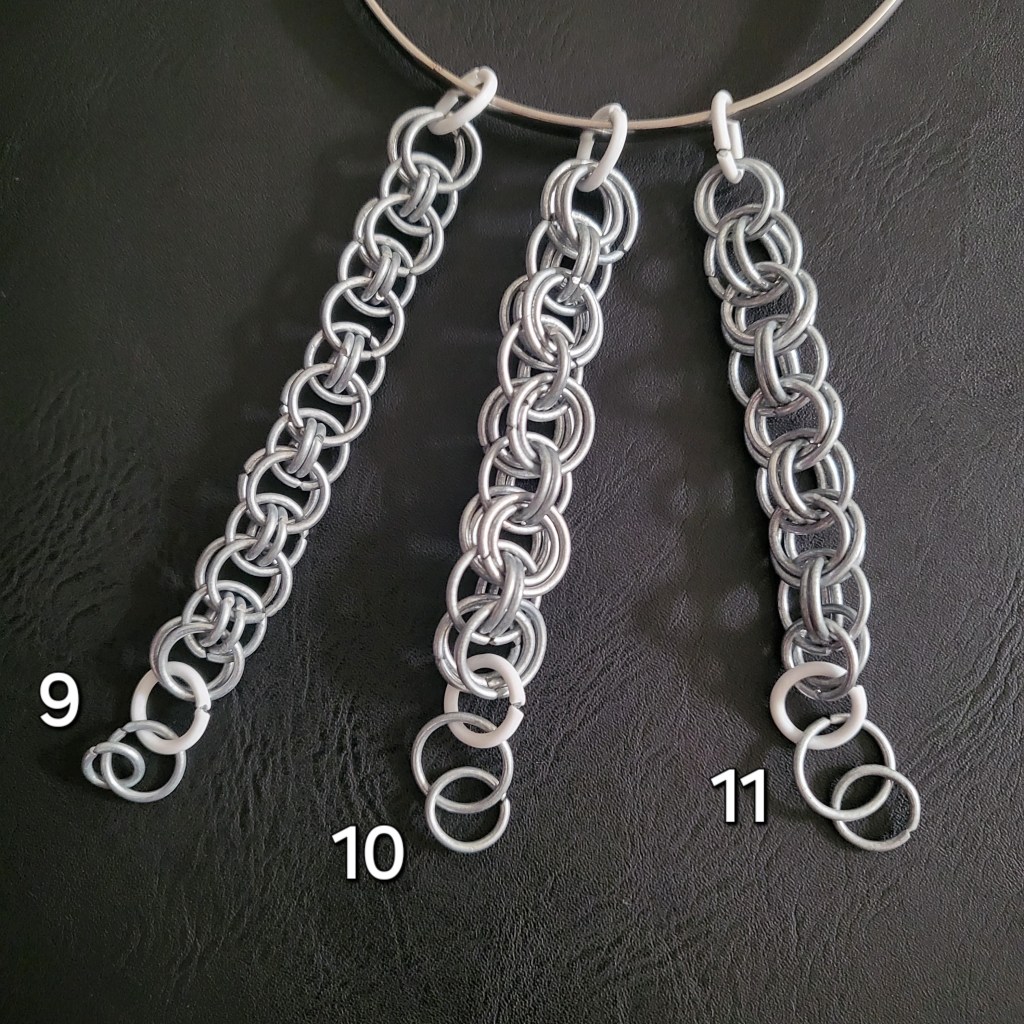
9 – Helm – A 4-in-2 chain made from 2 ring sizes with the smaller rings being surrounded by a larger one, which is kept in place by 2 other larger rings.
10 – Paddle wheel – This isn’t the best example of it, but this weave is a helm chain where the 2 larger rings that keep the middle one in place have an extra smaller ring nested inside of it. These smaller rings, when made with the same diameter wire, need to be an AR that is exactly 2.0 smaller than the larger ring. This is a weave that I quite like to play with as I like to make bracelets with a different pattern on each side (I call them ‘deception bracelets’).
11 – Helm orbiter – Similar to paddle wheel, except that the two larger rings have been replaced by a single ring that goes diagonally from one side to the other (not the best explanation, but you can see what I mean).
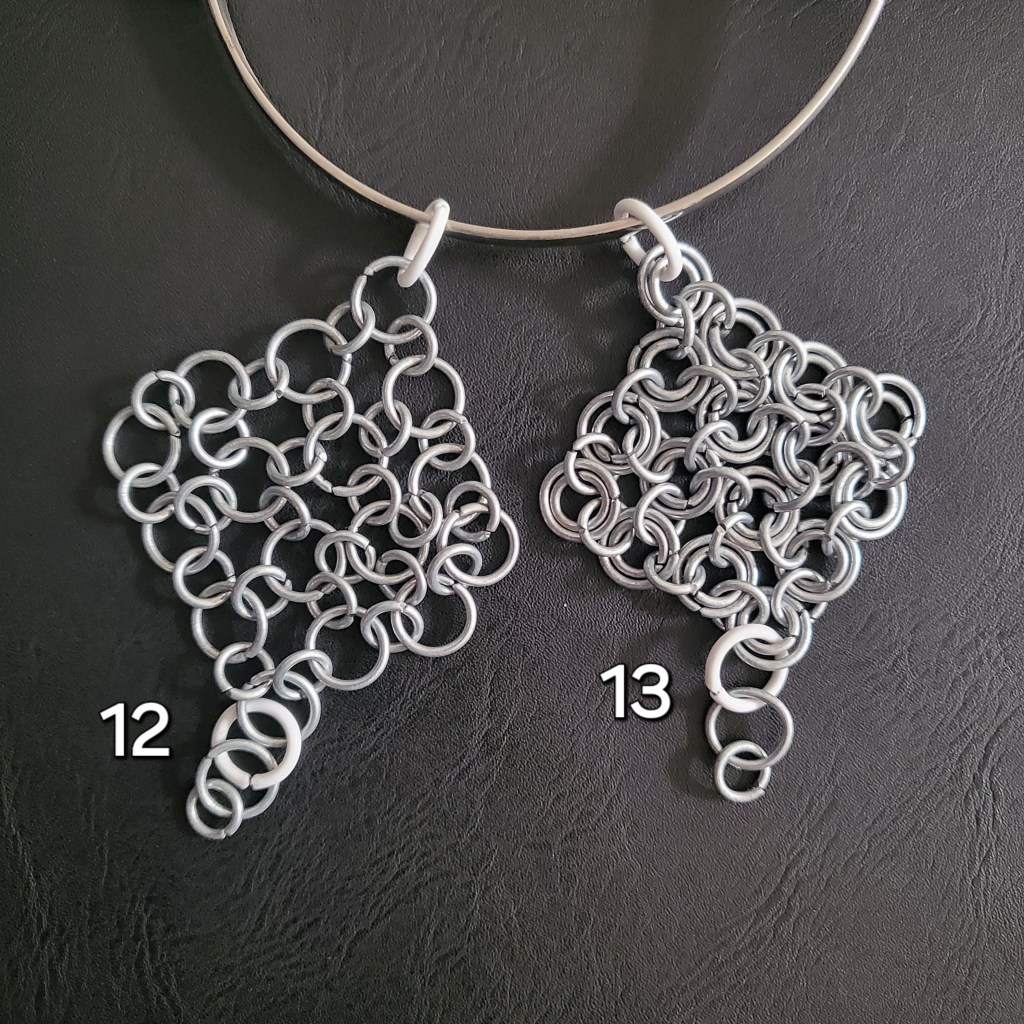
12 – Japanese 4-in-1 – A simple sheet weave where 4 smaller rings are connected to a single larger ring.
13 – ‘Captive Japanese 4-in-1’ – I don’t know if I made this one up or not, but this is what I’ve been referring to it as (although ‘nested Japanese 4-in-1’ is probably more accurate). Similar to Japanese 4-in-1, except there is an additional smaller ring inside of each larger ring. It makes the weave a bit more compact/dense.
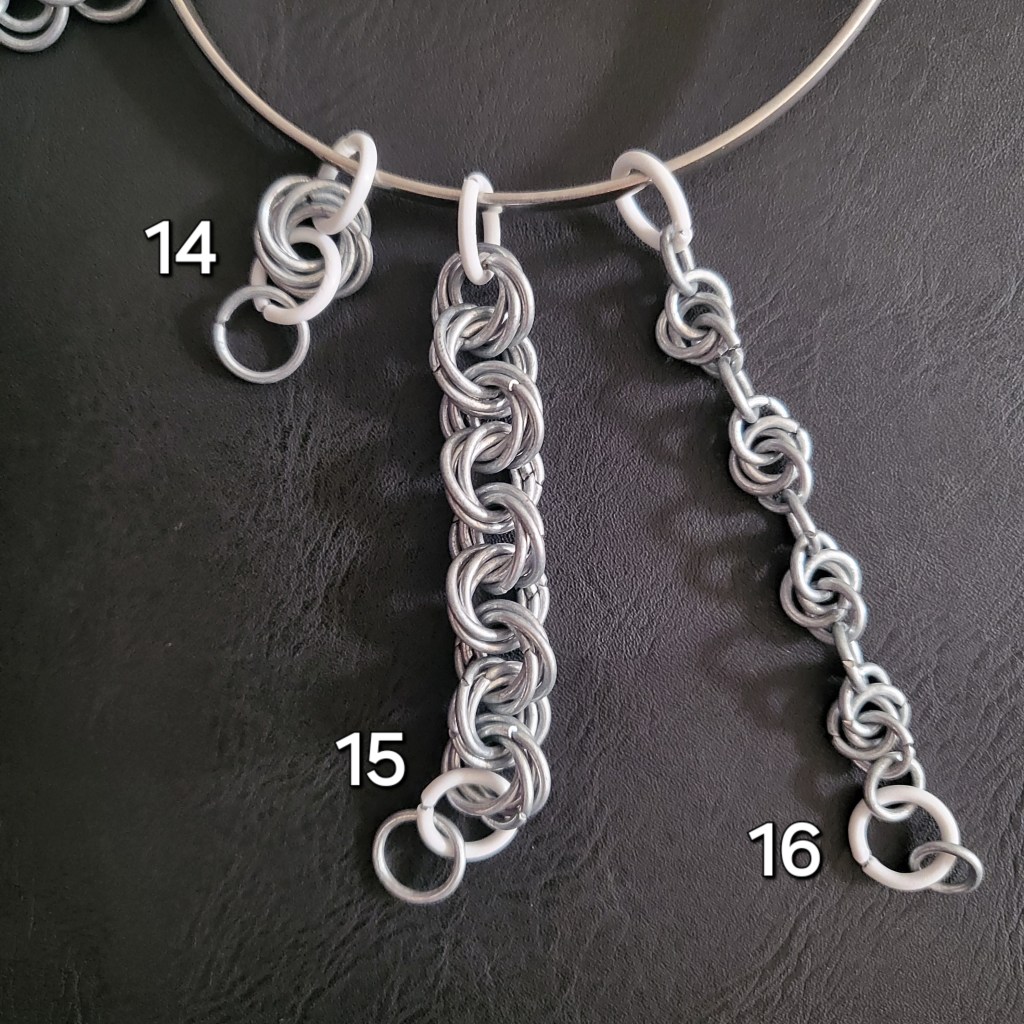
14 – Mobius ball (6 rings) – 6 interlocking rings that all face the same direction. Mobius balls can be made of as many rings as you want.
15 – Mobius ball chain (8-in-4) – Similar to a simple 2-in-1 chain, except the individual rings are replaced with mobius balls (in this case, made with 4 rings each).
16 – Fourever chain – 4 ring mobius balls that are connected to each other by another single ring. Each connecting ring is on opposing rings of each mobius ball.
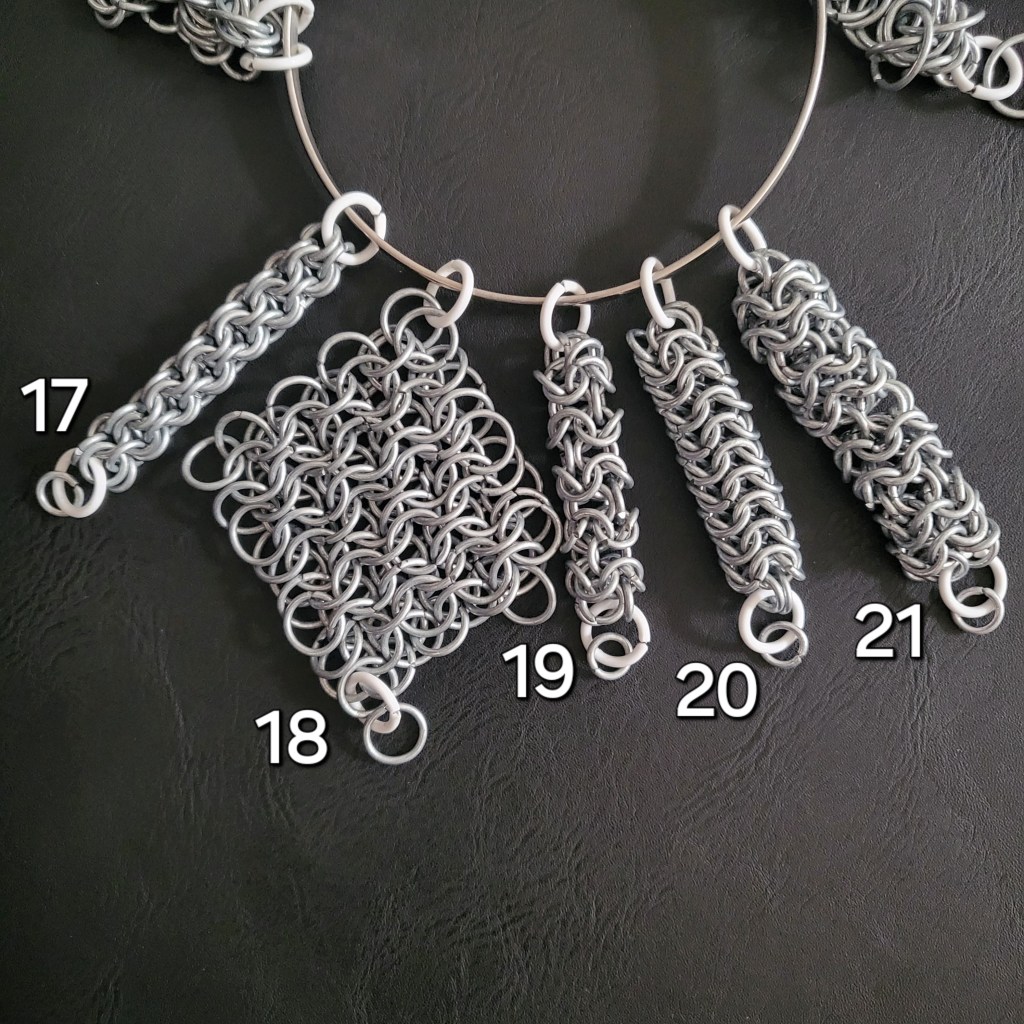
17 – Inverted round (3 sides) – I don’t really know how to describe this one…it’s a tube? You can add more sides to it too and it tends to work better with smaller ARs.
18 – Gracelock – A sheet of interlocking inverted round chains. This is my favourite sheet weave (and I kind of want to make a door mat out of it).
19 – Turkish round – A 3-sided inverted round chain with a Byzantine progression.
20 – Roundmaille – A 3-sided inverted round chain with a box progression. I think this one is growing on me; I need to use it more…also, apparently this is actually the base weave for this bit. Who knew? Still going to call this the inverted round group though.
21 – Druid rope – A 4-sided inverted round chain with a boxantine progression. I will warn you, it can bit tricky to keep track of things and it takes quite a while to make.
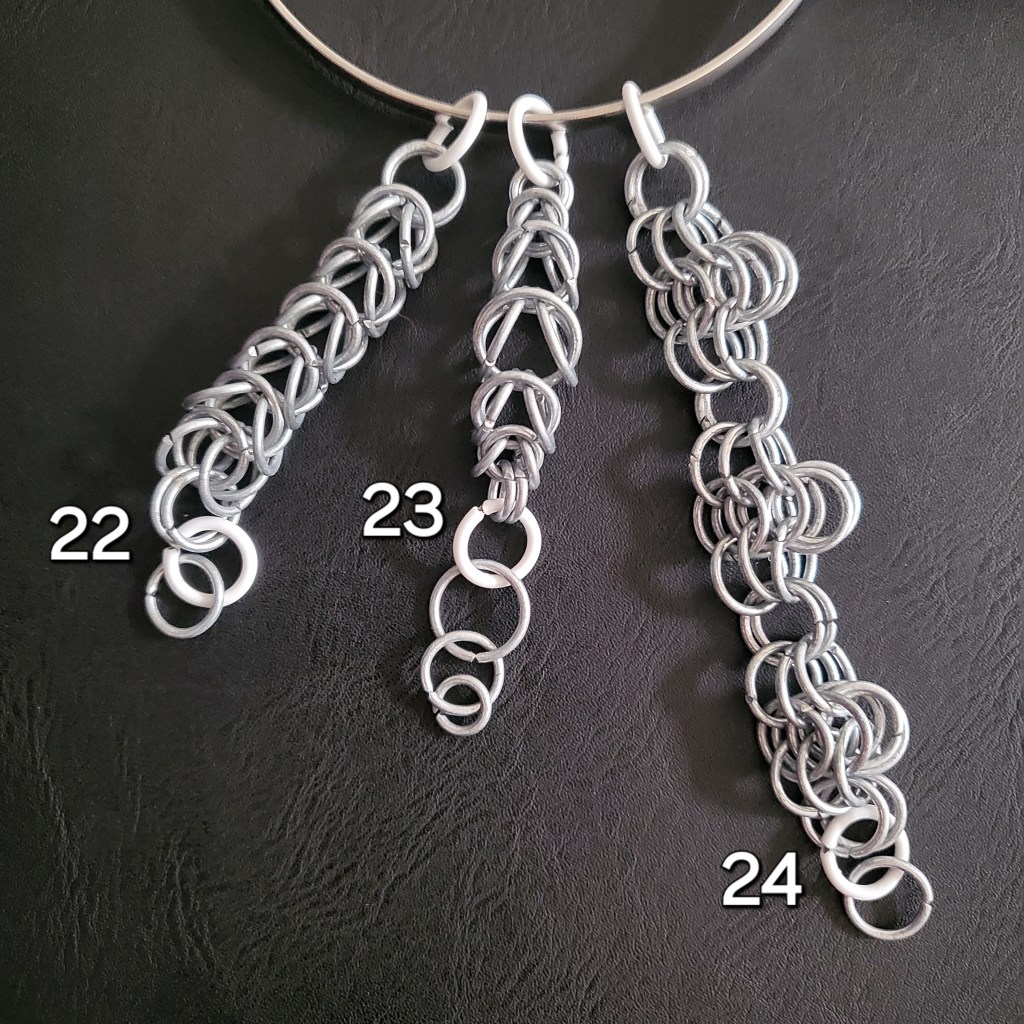
22 – Box – A simple chain weave with a square cross section.
23 – Box (with varying ring sizes) – …This is exactly what it says on the tin, really. I don’t know if this has a proper name or not.
24 – Box drops – Small sections of box chain connected to 2 rings by their sides instead of their ends.
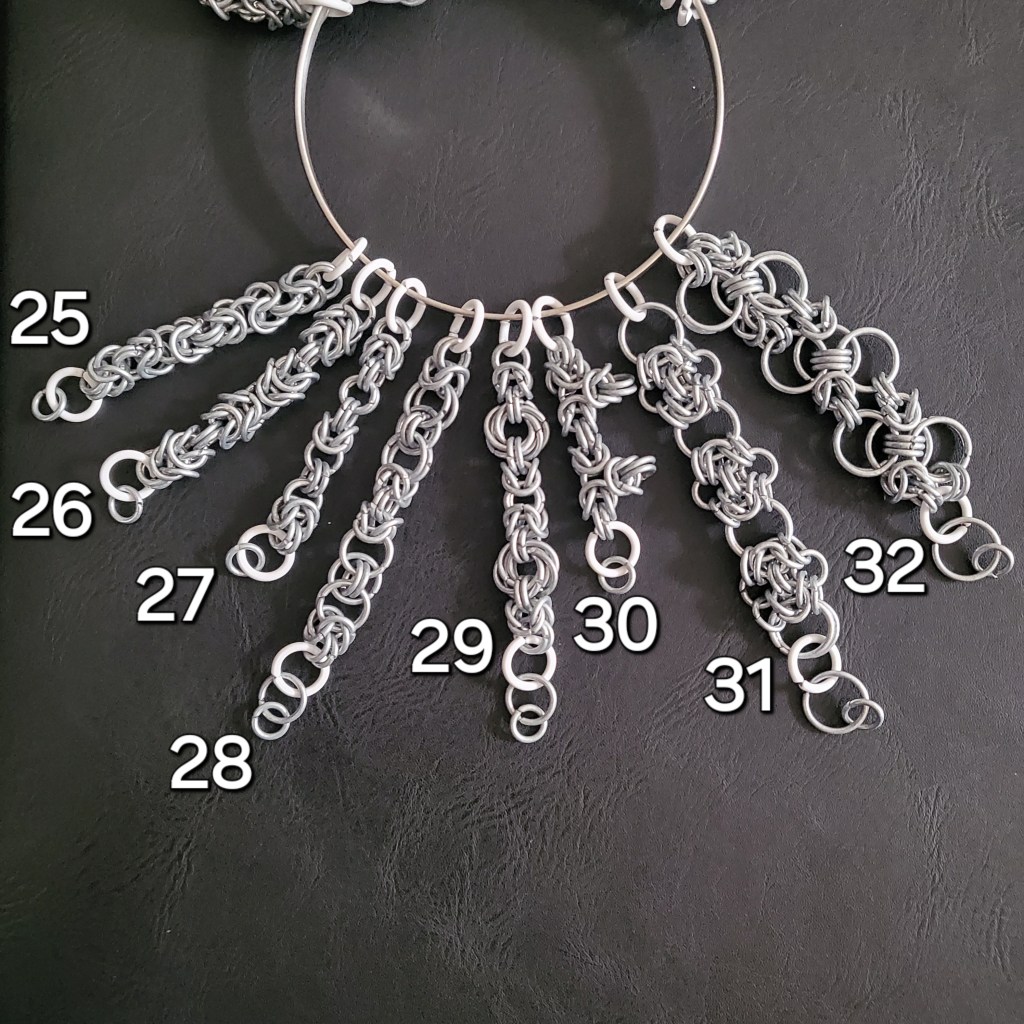
25 – Byzantine – Another simple chain weave, which is similar to box. I learnt to do this one for a friend’s Christams present last year and can’t believe that I waited that long – it is such a versatile weave!
26 – Boxantine – Not the best example (probably should have used rings with a bigger AR), but this is a mix of box and Byzantine.
27 – ‘Broken Byzantine’ – I don’t know the actual name for this, but this is what I have been referring to it as. It essentially adds 2 extra sets of rings to the Byzantine units. Can be done with a very small AR and still maintain its flexibility.
28 – Byzantine + helm – A chain that alternates between Byzantine and helm units. I don’t know if this has a name and I am probably not the first person to do this.
29 – Byzantine + mobius balls – A chain that alternates between Byzantine units and mobius balls. I find that this is quite fun for bracelets. Again, I am definately not the first person to do this and I don’t know if this has a name either.
30 – Byzantine thorns – Byzantine with an extra bit on each unit to make a triangular shape. I used this (in combination with mobius balls and some extra rings) to make a choker once.
31 – Byzantine bloom – Modified winged Byzantine units that alternate with larger rings in a chain. I have actually cheated a little bit with this one – I have only used 2 different ARs instead of 3…but it still looks good! I have also used this one to make a choker before.
32 – Beezley – Another one of my favourites (I think it kind of looks like barbed wire). I wasn’t quite sure where to put this one as it has elements of both helm and Byzantine, but I have put it with the Byzantines for now.
What I want to add next:
Well, I would start with the few weaves that I know how to do but just haven’t added yet. Winged Byzantine, alternating Byzantine thorns, and alternating box drops would be the easiest ones to start with as I already have the rings that I need for these. I would then add the 2 weaves that I don’t know if I made up or not but require higher AR rings that I just have not made yet. I have dubbed these ‘double Persian’ and ‘mobius Byzantine’, which are a varient of full Persian 6-in-1 and a Byzantine chain where the rings are replaced by 4 ring mobius balls respectively.
After that, there are other weaves that I want to try and learn, including –
- Fourever square, followed by moorish rose. I have been practicing mobius balls and using them in weaves quite a bit and, with any luck, I’ll be able to make moorish rose soon (a personal goal of mine).
- More European-based weaves, such as European 8-in-2, European 12-in-2, and dragonback.
- Some Byzantine-based sheet weaves, such as Byzantine ringmaille, Byzantine quads, and Byzantine square.
- Boxed Persian and half Persian (among other full Persian variations (really can’t believe I haven’t tried half Persian yet, though)).
- Some more helm variations, such as bee stings and bumpa.
- A couple more basic weaves – spiral and celtic (followed then by celtic dawn, Camelot, and coquille).
- Some other miscellaneous weaves that I have found – dancing dolphins, moon quads, captive zen, voodoo, and fox.
- I also want to try modifying/creating other new weaves…but we’ll see how well that goes.
Well, I think that’s it for the moment. Long story short – I intend to almost double the amount of weaves on the sample ring and, eventually, fill it up entirely. I think the ring will be able to hold roughly 100-120 different weaves, but who knows if I will be able to fill it up or not (I hope so). If nothing else, the more weaves I add the more fun it is to flick through.
I hope you all enjoyed my constant little side project. If you any suggestions for weaves that I can try, let me know!
– Natalie
Right, time for the album of the day then. I have decided to go with something a bit thematic – something metal. In my mind, you can’t really go wrong with a bit of power metal – The sacrament of sin – Powerwolf
 Natalie's notebook