So, every now and then, I like to create a cipher. I don’t decode or try and break other people’s ciphers, I just like the idea of writing something that no one else can read and it (sometimes) looking pretty. So far, I have created 4 ciphers (with this one being the fourth) and scrapped 2 others before finishing them.
I thought that I’d share this one with the world as it is probably the most elaborate one that I’ve made and I’m really proud of it. Enjoy!
The inspirations:
There were 6 main inspirations for this cipher.
1 – Tsevhu – the koi fish conlang:
This was the main reason for starting work on this cipher. I just fell in love with the idea of making a cipher that could be mistaken for a work of art or one that could be hidden away in something else. I never intended for this to be a practical or quickly-written cipher – I just wanted to challenge myself to create one where I used pictures instead of a more traditional sentence structure.
2 – Scrapped cipher #1:
This was the fourth cipher that I attempted to make. The main idea for this one was ‘what if I use sounds instead of letters?’. This meant that, instead of having 26 base characters to write with, there would instead be 44 base characters. This was due to using English phonemes instead of the English alphabet. With this cipher, I had intended to split words into syllables and for each syllable to be its own larger complex character made up of the base phoneme characters. Both the idea of using phonemes and splitting words into their individual syllables were used in my plant cipher.
3 – Plants (obviously):
I like plants. And, while I may not be a very good plant parent, I thought that they could be a fun subject for this cipher. You can make them as simple or intricate as you like. I could have each leaf represent a syllable. It’s something that could be hidden in the background of something else. Plants were the perfect subject.
4 – Scrapped cipher #2:
This was the fifth cipher that I tried to make and I dubbed it the ‘doctor’s handwriting cipher’ while I was trying to create it. This was because it was based on lines that all went the same direction and could be linked together with curves. It was intended to be written quick and look messy…it ended up looking a little bit like Russian cursive. Point is – it was a cipher made up of lines, and I repurposed that idea for this cipher.
5 – Codons:
Right, let’s start off with a brief explanation of what codons are…whilst trying to keep things relevant, of course. Codons essentially act as the code on DNA and RNA that instructs cells to create proteins. These codons are always made of a combination 3 bases. There are a total of 4 different bases that can be used to make up these codons – resulting in 64 possible combinations (e.g. AAA, AGC, CCG). It’s this idea of having limited building blocks in varying combinations that was used in this cipher, as I did not want the individual characters to be too complex or busy.
6 – Braille:
This was the inspiration for how I decided to treat the numbers. Instead of having 10 separate characters for each number, I decided to just use 1 character to tell you that it is a number and then assigned a number to 10 of the phoneme characters. This may not be the best explanation as to what I did, but I’ll cover it in a little bit anyway.
Nb – This is something that I misremembered about braille…I did not realise this at the time of writing, but it is still an inspiration nonetheless. – 08/06/2024
The characters:
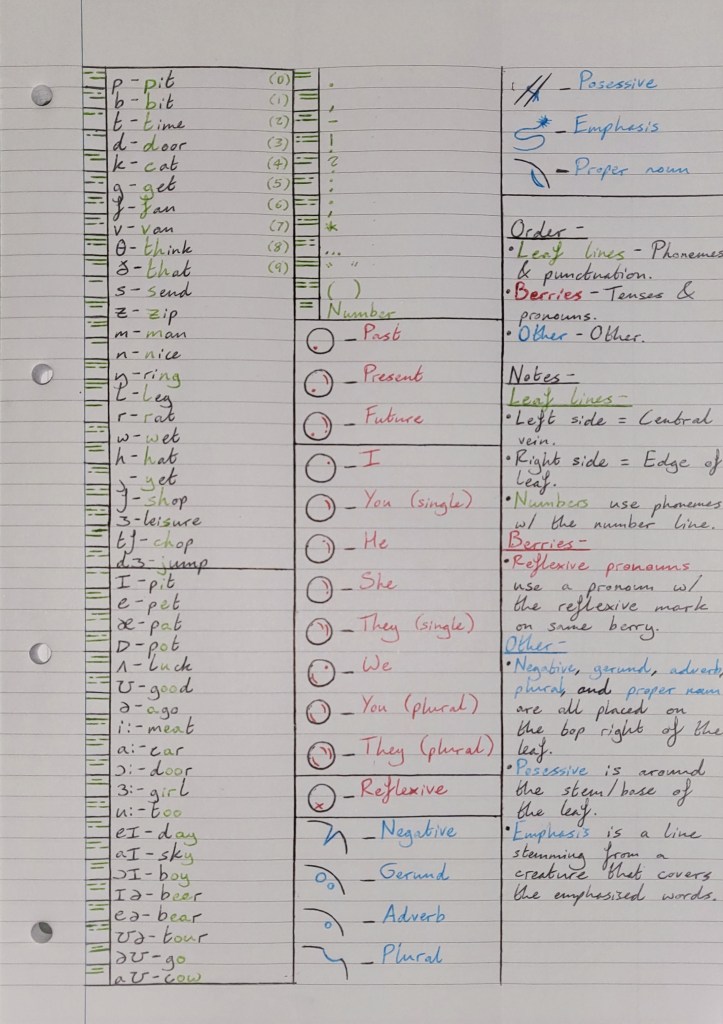
Note: I have made a slight modification to this since writing it all out. I have added the idea of using a blank berry to represent ‘to [verb]‘.
How to use it and how to read it:
Basic plant structure:
Each leaf on the plant represents a syllable. When these leaves are grouped together, they form a word along the stem.
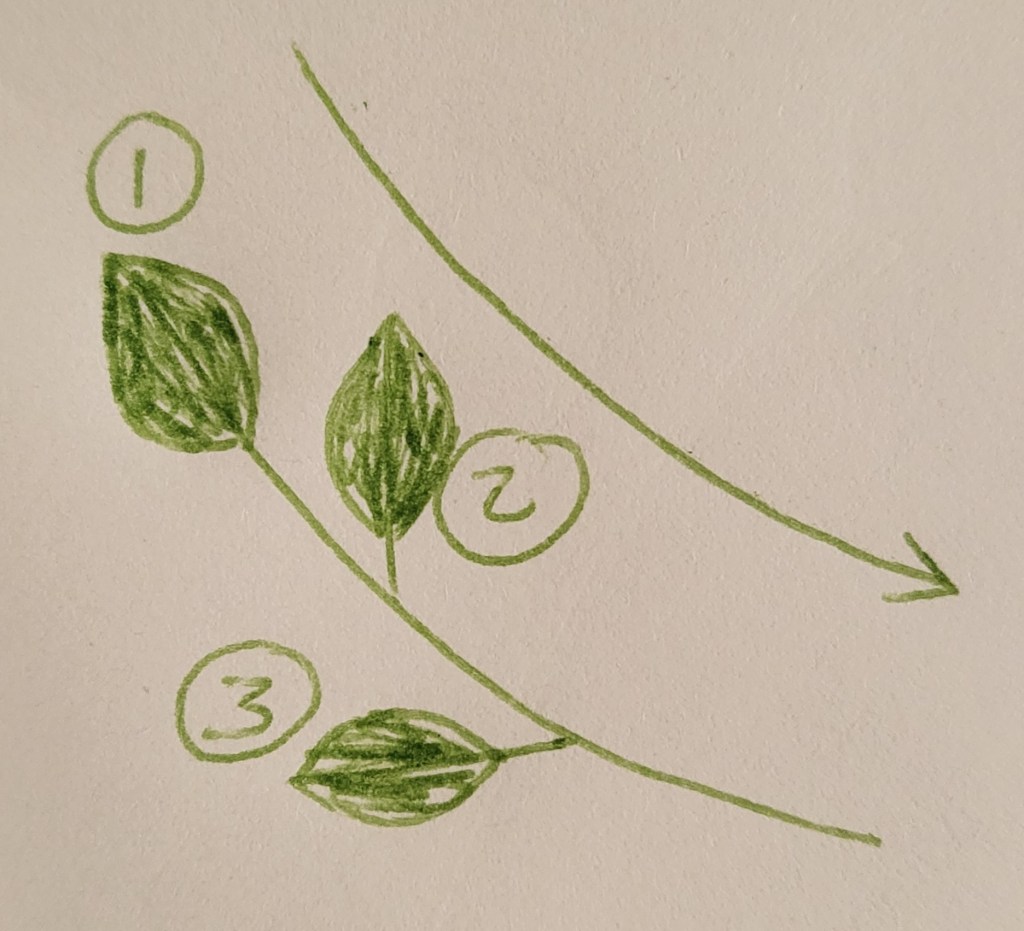
Plants are read starting with the top-most leaf and then working your way down towards the bottom of the stem. It doesn’t matter what side of the stem the leaves are on; you always work your way down.
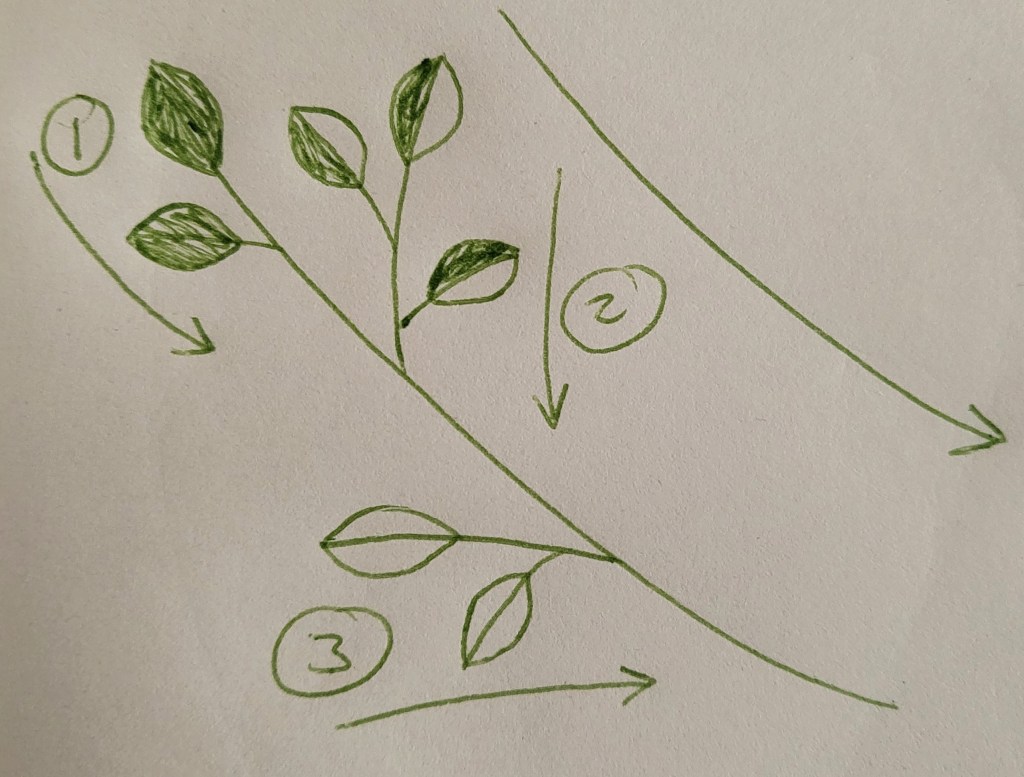
If you have multiple words, you again work your way down the stem. Word [1] is read top leaf to base, you move down the stem and then word [2] is read from top leaf to base, you move down the stem again and so on. I believe this picture shows that better than I can describe it.
It doesn’t matter what shape the stem is or which direction the plant is facing, they are read and arranged the same way.
Basic leaf structure:
Like the plant’s structure, the structure of the leaves is always the same. The leaf colour doesn’t matter. The overall leaf shape doesn’t matter. You can customise their main features however you wish. Just use whatever fits your piece best.
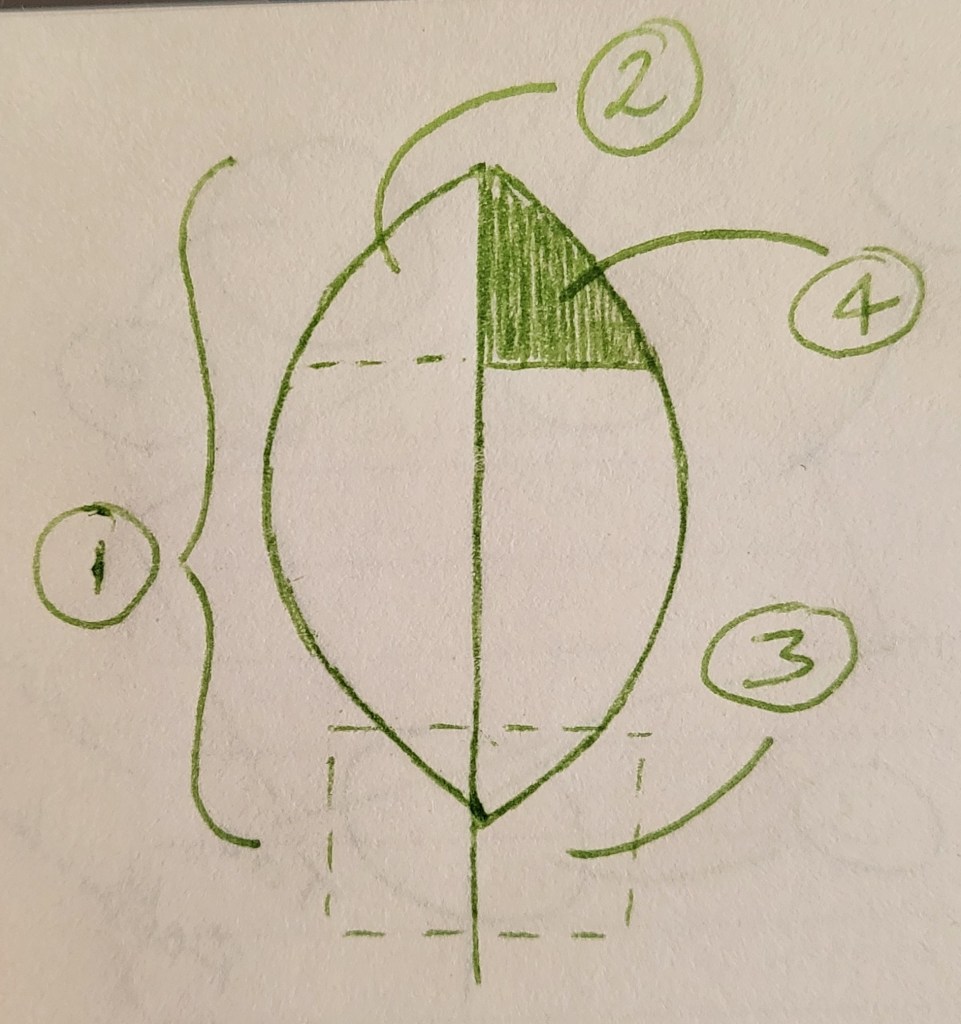
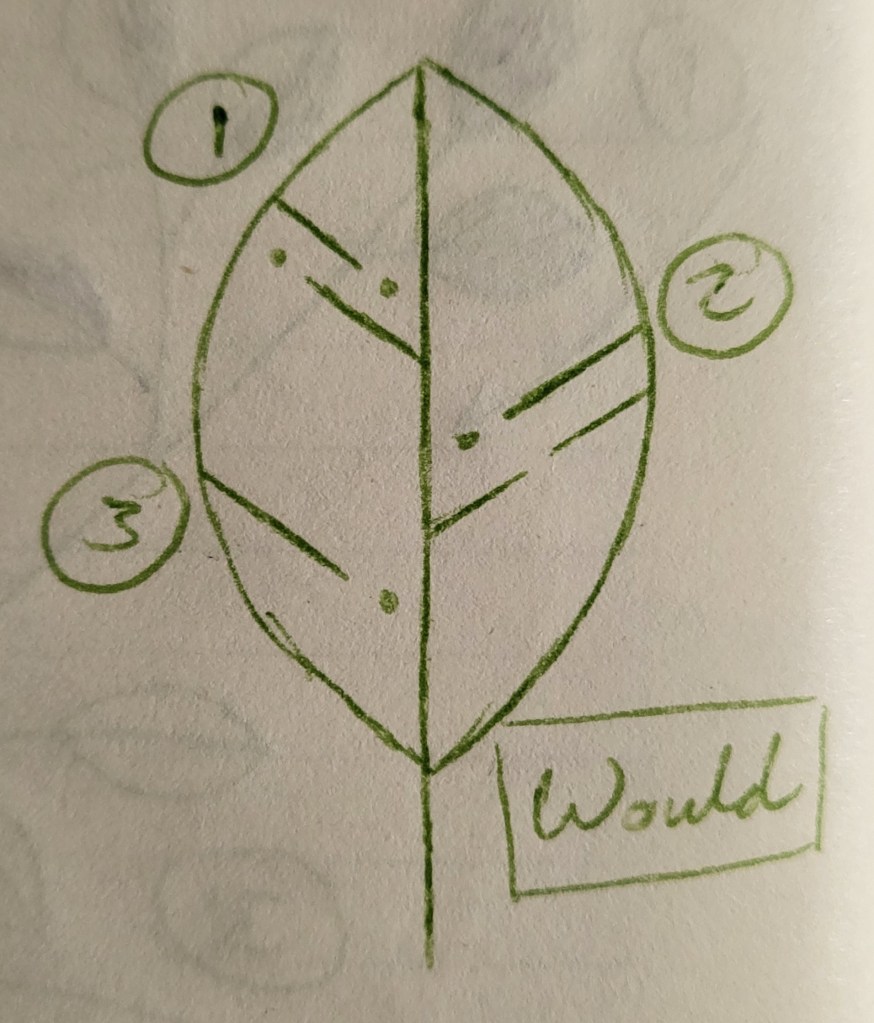
The leaves themselves can be split up into a few different sections, as seen in this image. Section [1], the white part of the leaf, is where the leaf lines are placed, with section [2], the top left part of the leaf, being where the first leaf line of any given leaf goes. Section [3], the base of the leaf, is where the berries are placed. And section [4], the top right part of the leaf, is where all but 2 other modifications to the plant placed.
The leaves are read from tip to base and the leaf lines alternate down the central line of the leaf. You always start in the top left [2].
Using leaf lines:
The leaf lines are meant to imitate the veins on leaves. These leaf lines, in various combinations, represent the 44 phonemes and a decent range of punctuation. These lines determine what words sound like and how sentences are structured.
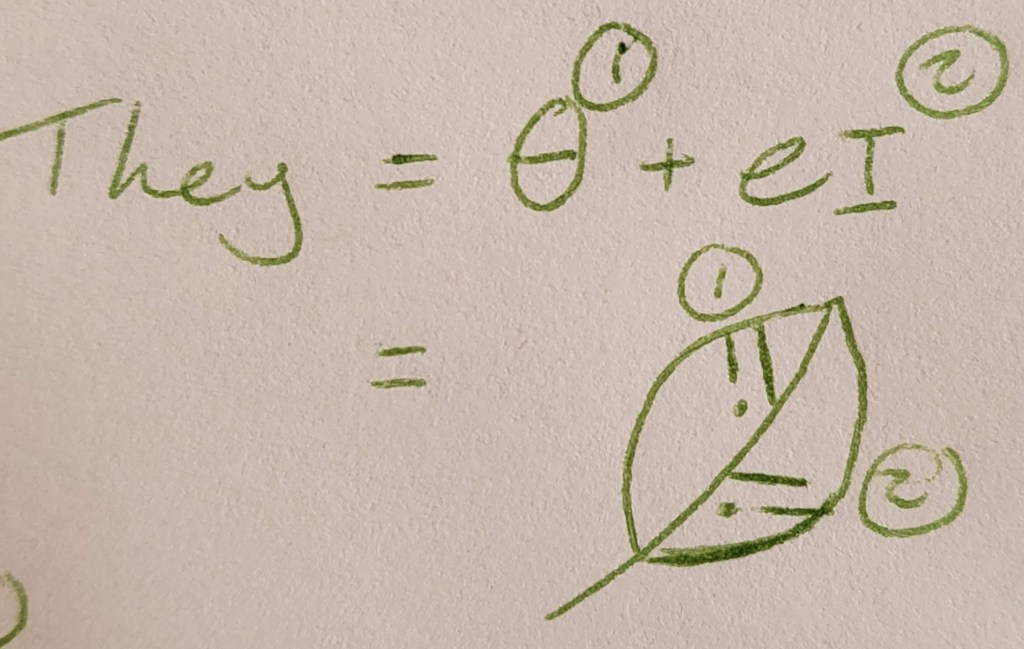
Let’s use the word ‘they’ as an example. The word ‘they’ is a single syllable and is therefore written on a single leaf. The word is comprised of 2 sounds – a short ‘th’ sound [1] and a longer ‘ay’ sound [2].
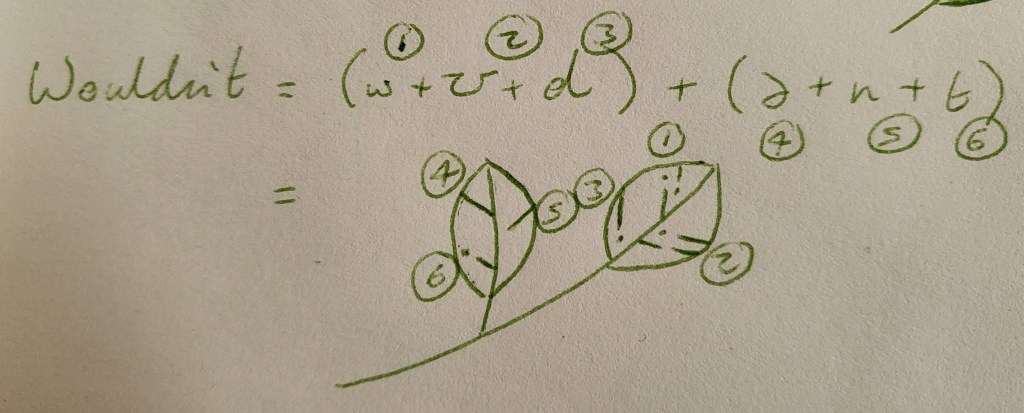
Another example that we can use is the word ‘wouldn’t’. The word ‘wouldn’t’ is 2 syllables and is therefore written across 2 leaves. Even though there is an apostrophe in the word, it is not included in the cipher as it doesn’t really change the sound of the word.
The first (top) leaf is comprised of 3 sounds – a ‘w’ sound [1], an ‘oo’ sound [2], and a ‘d’ [3] sound. This makes the first syllable ‘would-‘. The second (bottom) leaf also has 3 sounds – a quiet ‘uh’ sound [4], an ‘n’ sound [5], and a ‘t’ sound [6]. This makes the second syllable ‘-n’t’.
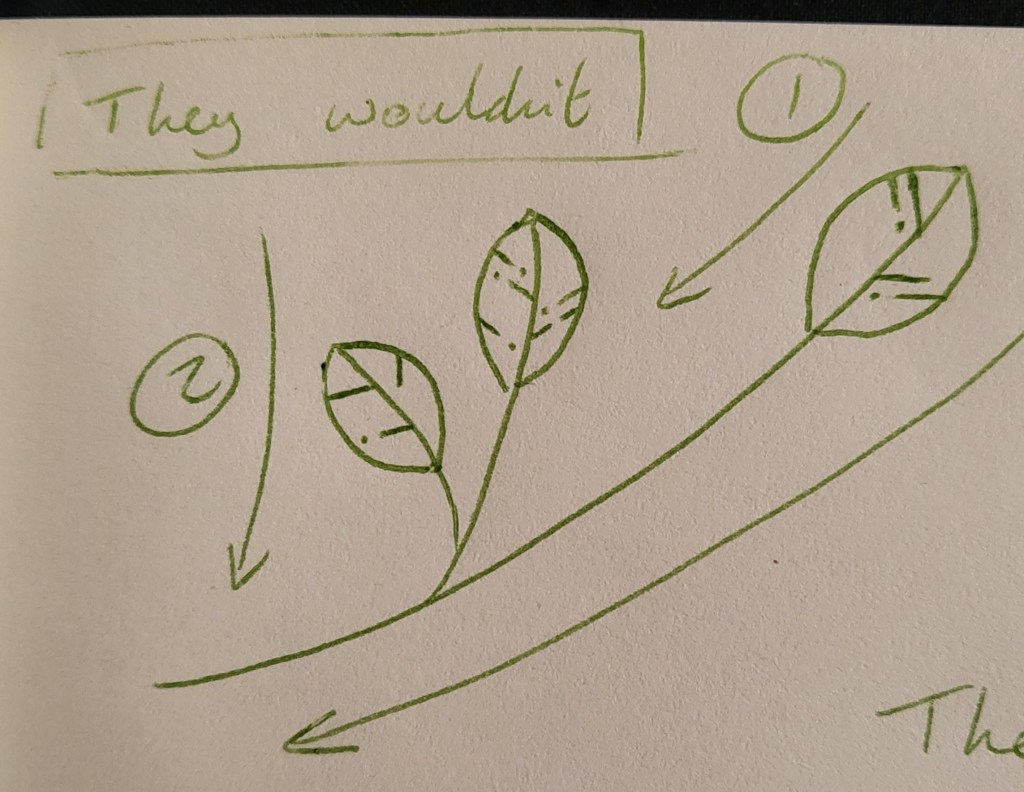
If you put these two words together, this is what it would look like. ‘They [1] wouldn’t [2]’.
Using berries and other plant modifications:
In some cases, you can use berries and other modifications to the plant to condense down phrases. The berries are used to denote tenses and pronouns and the plant modifications are used to denote various other things such as a gerund or whether something is possessive. To demonstrate this, let’s use the example ‘they wouldn’t’ again.
When using berries with a verb, the leaf lines are used to write out the base form of the verb. In the case of ‘they wouldn’t’, you would just write out the word ‘would’.
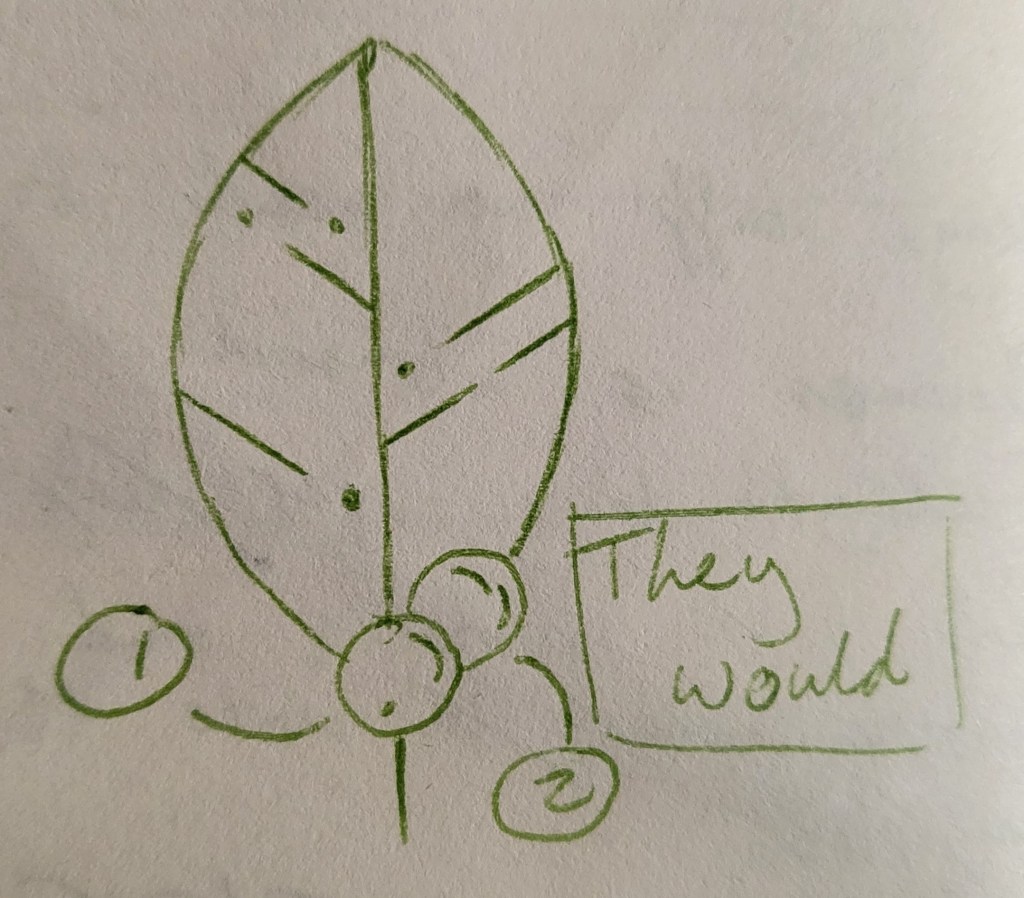
Next, you add the berries. For this example, you would use 2 berries. Berry [1] shows that the verb is in the present tense and berry [2] represents a singular they. When read with the leaf, this results in the phrase ‘they would’.
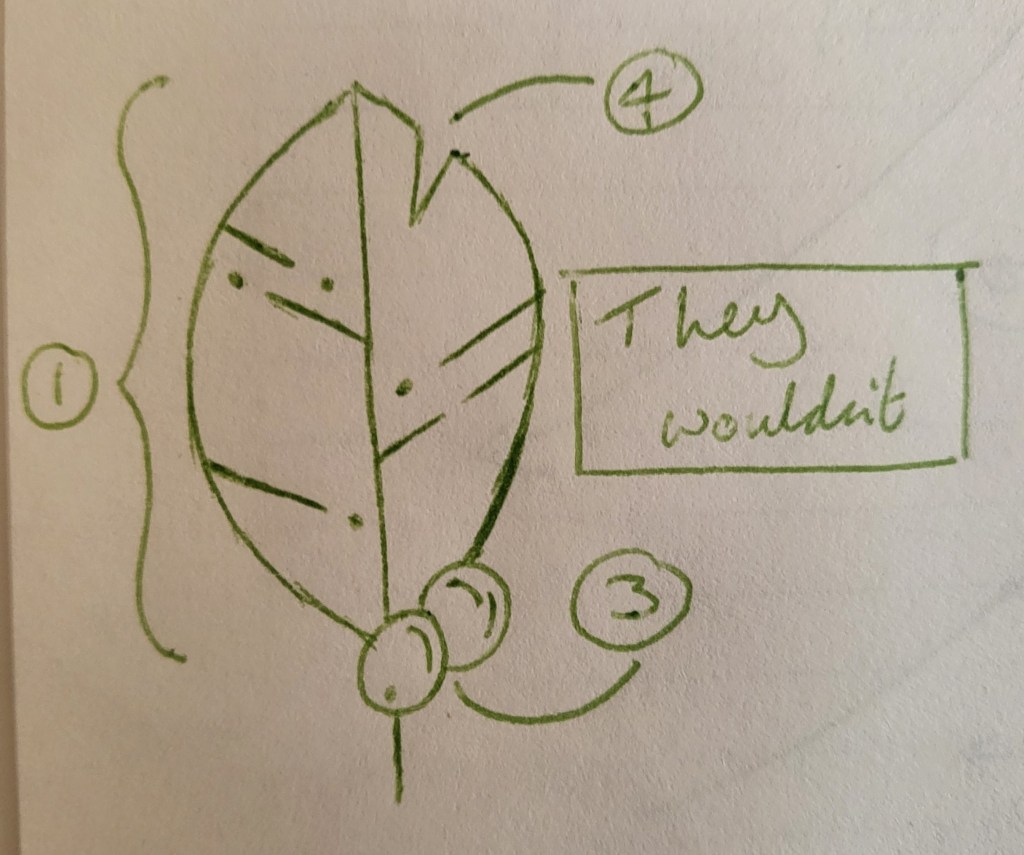
Lastly, you add any other additional modifications. In this example, we are using the negative. This is represented by a triangular notch in the top right edge of the leaf. When comparing this back to our basic leaf structure, section [1(&2)] contains the base verb written out using the leaf lines, section [3] has both the tense of the verb and relevant pronouns to the phrase in the form of berries, and section [4] contains some other relevant information to the phrase using modifications to the base leaf/plant.
Note: You can use this cipher in 2 different ways – a simplified and very literal way using only leaf lines and a more complex and compact way using berries and other modifications…and I like that. I like it when the same thing can be written in different ways.
Using the 2 non-leaf modifications:
There are only 2 modifications to the plant which do not modify the leaves. The first denotes the possessive and is something, such as a piece of string, which is tied to the plant stem at the end of a word. The second denotes emphasis to a word or phrase and is represented by a trail coming from a small creature that encompasses the leaves and/or stems of the word or phrase it relates to. You will see an example of both of these in some of the pieces that I’ve done.
How numbers work:
Like English, this cipher uses arabic numerals and, as previously stated, the method used to denote this is based on the system used for braille. This means that there are a total of 10 different, but not unique, characters to represent each number and an 11th character to tell the reader that they are looking a number. This is because the 10 character used for the numbers are shared with 10 of the phonemes. E.g. 0=p, 1=b, 2=t…
Unlike the rest of the cipher, numbers are not divided up into individual syllables. Instead, each number has its own leaf.
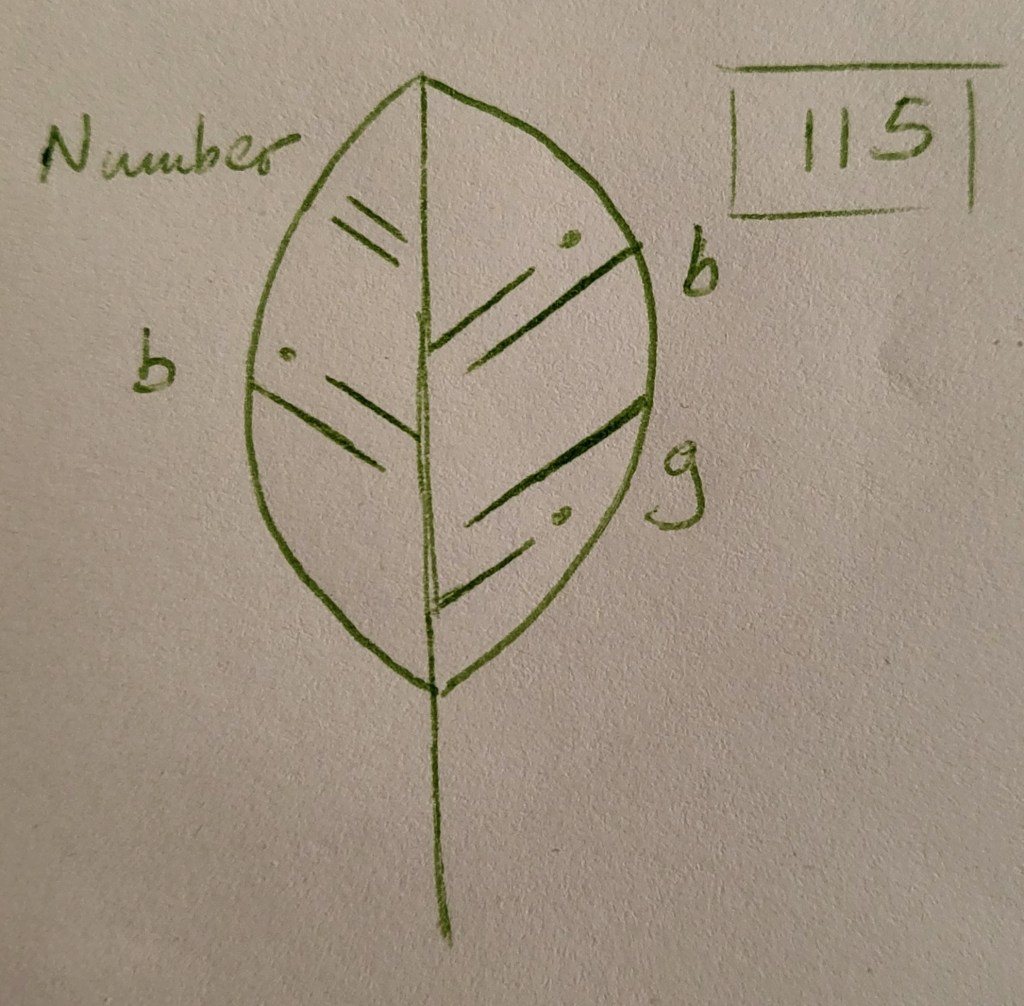
This example depicts the number 115. This is written with the number character first, followed by the characters b, b, and g. In combination with the number character, b=1 and g=5, resulting in the number 115.
Some pieces that I’ve done:
#1 – The first verse of Gloomy Sunday:
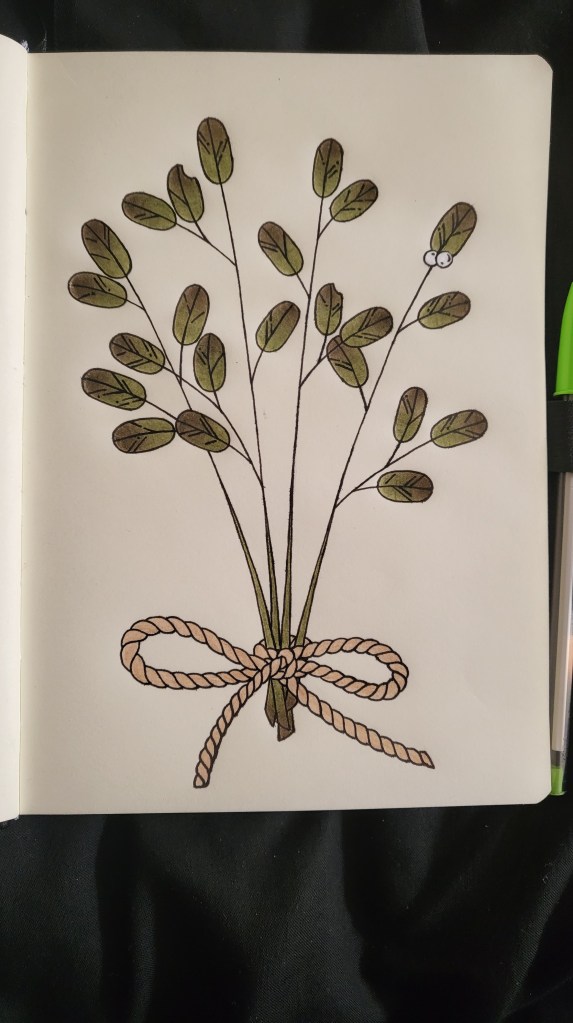
Sunday is gloomy
My hours are slumberless
Dearest the shadows
I live with are numberless
This was the first piece that I did beyond a couple of very rough test pieces…and I’m so happy with how it turned out. Granted, I did make a couple of mistakes but, for a first proper go, I’d say it’s pretty good.
I wasn’t quite sure what leaf shape to use, so I just decided to go with something simple that would offer a decent amount of space to work with. In terms of the leaf and stem colour, I wanted to go for darker/dirtier colours and I found these 2 went together nicely. I also found that white berries contrasted with the darker colours of the leaves nicely – made them pop.
Now, as for the rope tying the 4 stems together. The rope relates to the song itself. Another name for gloomy Sunday is the Hungarian suicide song. The rope that I chose to use is meant to resemble one that could be used for a noose. I chose not to use the hangman’s knot, but I think it ties the piece together quite nicely (no pun intended).
As for the mistakes that I mentioned earlier…I made 2 pretty big ones. First was the fact that I used the wrong phoneme at the end of ‘gloomy’. I used the ı sound instead of the i: sound and I didn’t notice until after I had already finished my second piece. Second was the pen that I chose to line the piece with. Although I did some testing beforehand, the pen bled. It may not be much bleeding, but it still bothers me.
#2 – Hazbin hotel fan art:
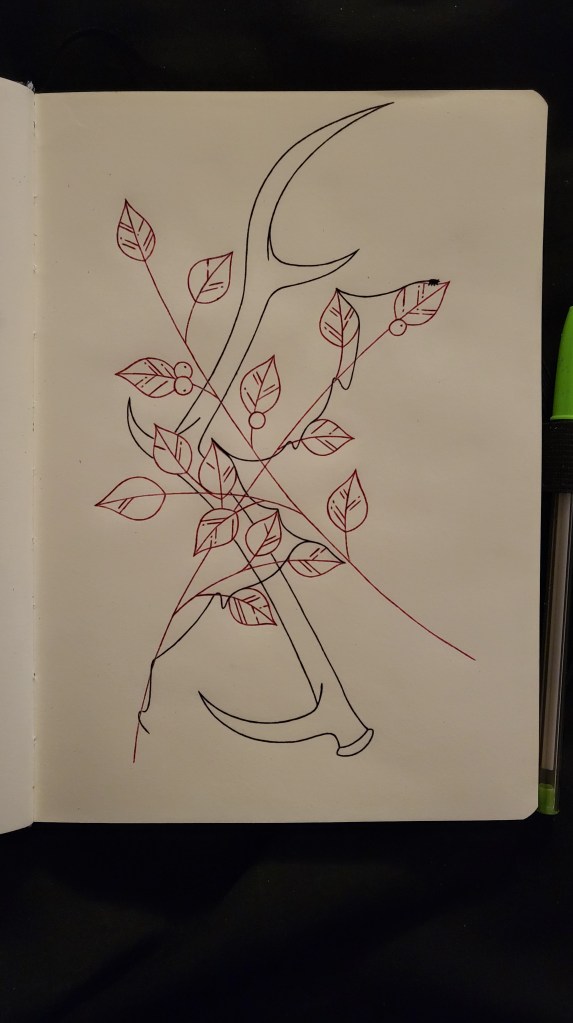
“Dear, if I wanted to hurt anyone here…I would have done so already.”
This one ended up being kinda messy/difficult to read, but I still think it turned out well. There were couple of reasons why chose this quote as the subject for this piece – 1) I like Hazbin Hotel and Alastor is my second favourite character (only beaten by Rosie) and 2) I wanted to see what adding emphasis to a piece would look like in practice (as the second half of this quote is emphasised static and distortion when spoken).
The overall colour scheme is red and black to reflect Alastor’s main colours. The leaves are a pointed teardrop shape and are intended to mimic the head of Alastor’s staff. The plants are arranged in an ‘X’ shape to represent the ‘X’ that appears on Alastor’s forehead. And the deer antler in the back…well, he is a deer demon (I’m sure you can figure out why that’s there).
Also, I made the same mistake in this piece as I did the previous one with using ı instead of i:. Oops.
#3 – The word asexuality:
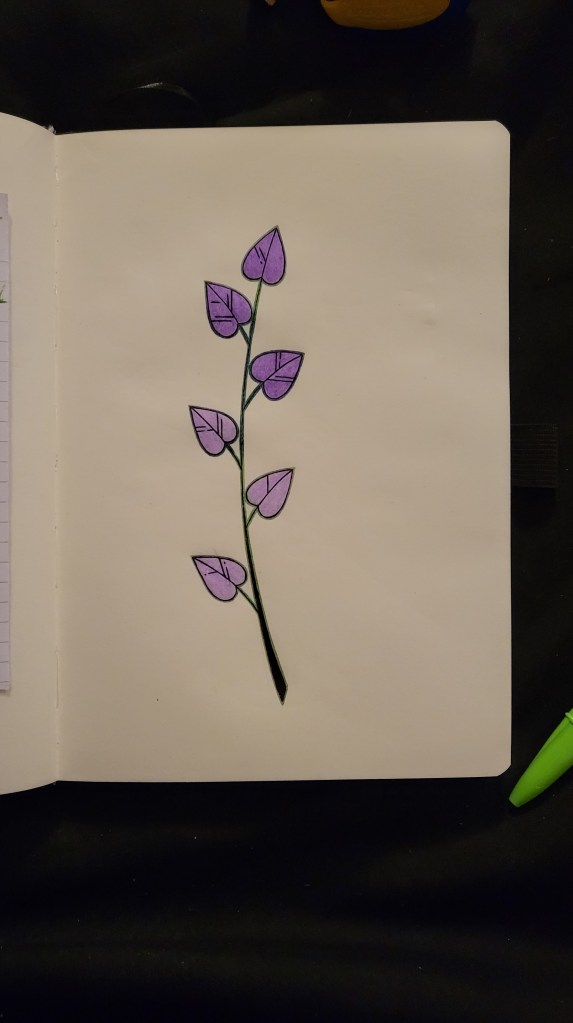
Asexuality
There’s not really too much to say about this one; it’s pretty simple. The leaves are heart-shaped to represent all different kinds of love (and just sexuality in general) and they are purple to represent the purple stripe on the asexual flag. The outline around the whole piece, which admittedly is quite tricky to see, is two different shades of green and is meant to represent the green stripes on the aromantic flag. And…that’s it really. I warned you that there wasn’t a lot to say about this one.
#4 – Questioning whether I should do a Master’s degree or not:
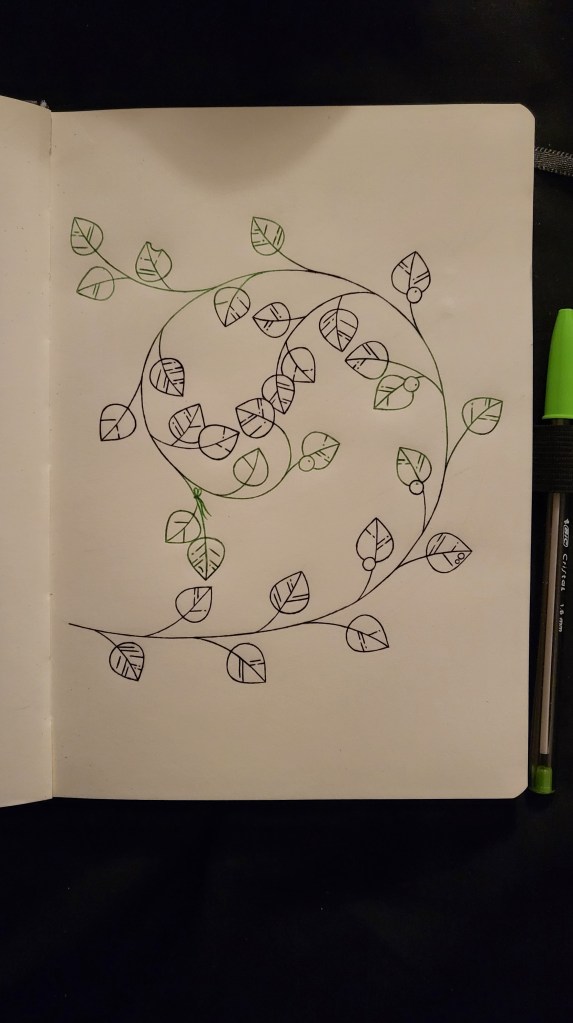
Should I do a Master’s degree in plant genetics and crop cultivation? I’m worried that I’m trying to do too much all at once.
This is just a reflection of my own thoughts and I decided to use it to experiment and practice a bit. The main things that I wanted to try were doing a gradient for the main outline and doing a piece that is just one long plant.
For the outline, I chose to do a gradient between green ( because it relates to the subject matter) and black (…because I like black). In order to achieve the single long plant thing, though, I decided to arrange the plant in a spiral so it fit nicely on the page with minimal overlap. Another way that I also minimised overlap was by using little fat leaves so that they could fit in the surrounding space more easily and also have enough space on the leaves to detail the characters.
Overall, this is another piece that I think turned out really nicely. And, in case you’re wondering what the answer to the question is, I decided that now is not the right time for me to be pursuing a Master’s…although I did start the application for it.
#5 – Delicious hypocrisy:
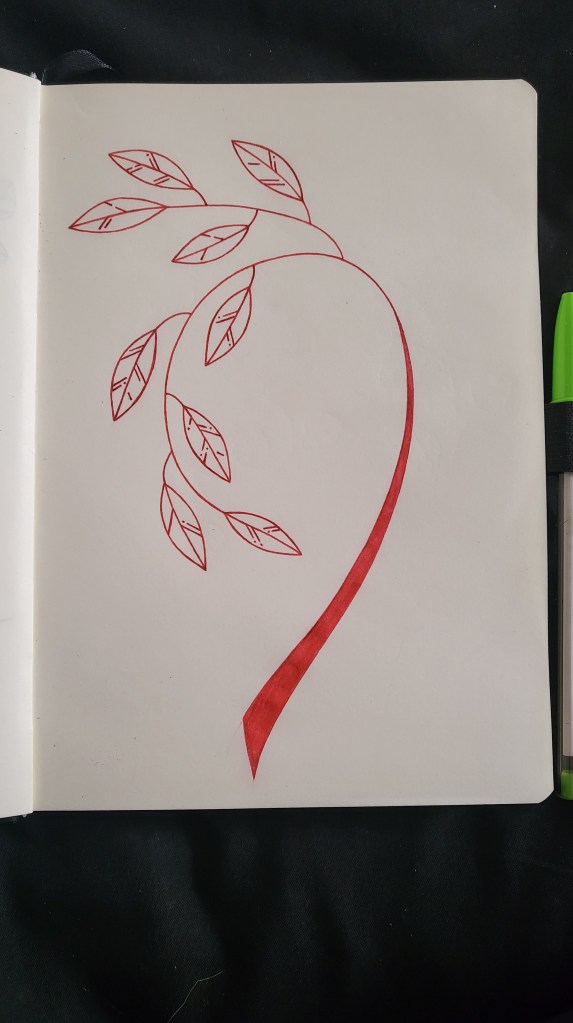
Mmm…the sweet smell of hypocrisy.
There is really nothing to say about this one. I was just annoyed at stuff happening at work. Guess the leaf shape is new though…
#6 – Potion seller (part 1):
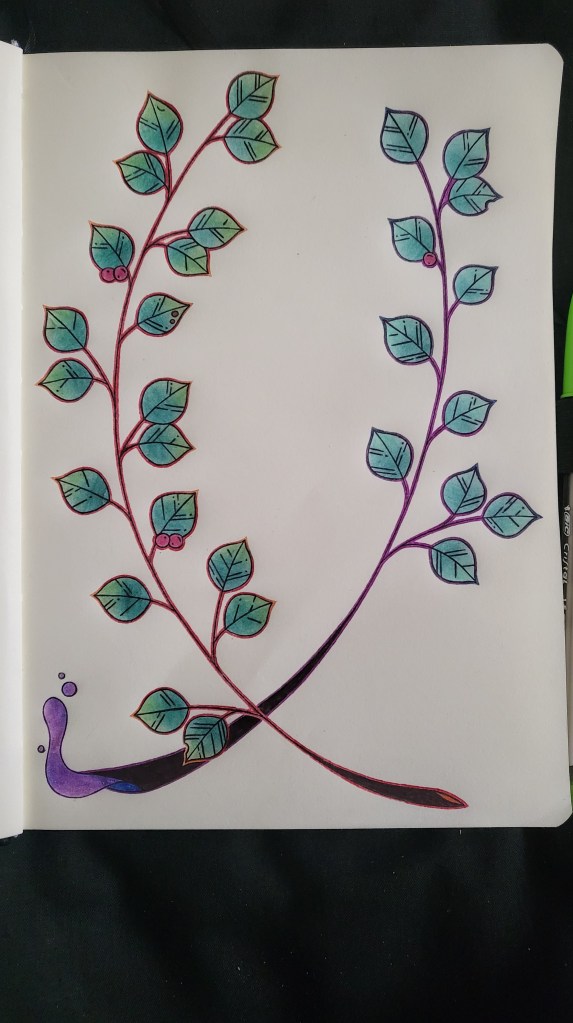
“Hello, Potion seller, I am going into battle and I want your strongest potions.”
“My potions are too strong for you, traveller.”
This is just the start of the (essentially ancient) potion seller meme. I wasn’t sure what I was going to do as my next piece and then I came across a script for this. And now, I want to write out the whole thing out over several pieces.
I decided to do this as two separate, but similar, plants. The plant on the left represents the traveller and has a warmer colour scheme – including red and orange around the outside and a warm green in the leaves. The plant on the right represents the Potion seller and has a cooler colour scheme – with dark blue and purple around the outside, turquoise in the leaves, and a purple and pink liquid coming out of the stem (which was meant to look like a little bit of potion).
I decided to keep the leaves a simple shape and made them a little bit smaller and chubby so I could fit them on the page easily. I also kept the leaf shape simple so that it could be continued in future pieces with relative ease. The berries are a darker red on both plants as it compliments both colour schemes nicely and serves as a link between the two plants.
Where do I want to take this next?:
Well…I want to do the rest of the potion seller meme. I want to experiment with things more. I want to fill the notebook that I’m using for all of this. I want to make bigger pieces (you know, bigger than A5). And I want to branch out into other media (I already have an idea of what I want to do).
Safe to say, I have plans. At the moment, they are mostly rather vague plans…but they’re still plans. So far, I’m really enjoying this one and I want to see what I can do with it. Although, I will say, I already have an idea for the next cipher that I want to try…and it involves another hobby of mine.
But, for now, I will say farewell and, with any luck, I’ll see you all again soon.
– Natalie
Right, time for the album at the end. I’ve been listening to these songs on repeat for almost the last week (especially the last one). What can I say? I’m a sucker for songs with story. So, here you go – The tale of Jenny & Screech – Ren
P.s. Holy shit; I actually did it! I posted something and it didn’t take 4 years (this time)!
 Natalie's notebook
2 thoughts on “I made a plant-themed cipher”